Mostrando entradas con la etiqueta black hole. Mostrar todas las entradas

miércoles, 10 de abril de 2019

Así es el primer agujero negro fotografiado por la humanidad

Publicado el 10 de Abril de 2019

El de M87 es el primer agujero negro del que tenemos una foto real tras 40 años de representaciones artísticas
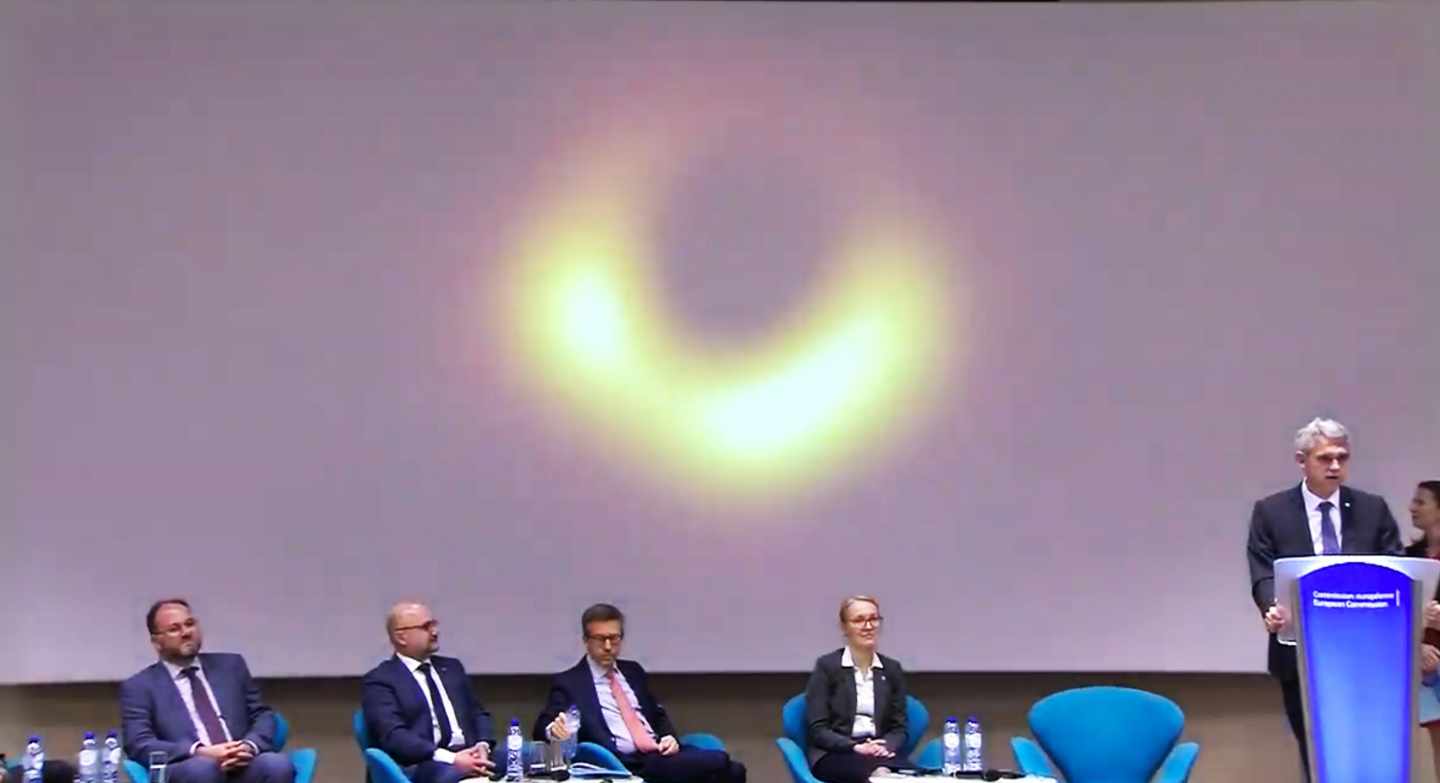

Presentación del primer agujero negro fotografiado
Presentación del primer agujero negro fotografiado 
El de M87 es el primer agujero negro del que tenemos una foto real, después de 40 años  de imágenes generadas por ordenador o salidas de la mente de artistas. Los resultados han sido presentados esta tarde a través de siete ruedas de prensa simultáneas desde distintos puntos del mundo.

Casi un siglo después de que un Eclipse encumbrase a la fama a Einstein, sus ecuaciones brillan en forma de sumidero cósmico. El primer agujero negro ha sido cazado por el llamado Telescopio del Horizonte de Sucesos (EHT), un equipo internacional que ha orquestado el trabajo de ocho radiotelescopios terrestres, incluido el IRAM 30m de Sierra Nevada, en España. Un agujero negro es un objeto con tanta masa que atrae irremediablemente a todo cuanto se le acerca, incluida la luz, que queda engullida en su interior.


En España, el resultado de esta investigación se ha presentado en el CSIC desde Madrid. “Ya no hay más simulaciones. Estamos viendo, por la primera vez, un agujero negro real”, ha dicho en la rueda de prensa internacional desde Bruselas el ingeniero español Carlos Moedas, comisario europeo de I+D+i, quien ha subrayado que la “ciencia da una lección a los políticos”, en relación a la colaboración internacional.
El equipo ha perseguido dos objetos particularmente interesantes: el corazón de nuestra galaxia, donde habita el agujero negro supermasivo Sagitario A*, y el de la galaxia Virgo A (M87). El primero, pone a bailar a todos los objetos de la Vía Láctea y su existencia fue confirmada en 2002 por Reinhard Genzel. El segundo es una de las fuentes más potentes de radio del universo.
Un agujero negro está revestido normalmente de gas. La enorme gravedad generada en sus inmediaciones provoca que gire en espiral. Se forma lo que se conoce como disco de acreción. La velocidad a la que gira el material que no termina de entrar en la garganta del agujero hace que se encienda en forma de radiación electromagnética. La luz visible es parte de ella.

Una proeza para dar la razón a Einstein

El EHT estuvo realizando fotos durante 10 días en abril de 2017. Al equipo astronómico les ha llevado dos años cotejar los resultados. Los datos eran tan voluminosos, que era impensable transmitirlos por red. Tuvieron que ser almacenados en discos duros y trasladados en avión al Observatorio Haystack del MIT (EE.UU.) y al Instituto Max Planck de Bonn (Alemania). Hubo que esperar a diciembre de 2017 para recoger los discos del telescopio antártico, ya que hasta entonces era invierno y durante esos meses nada puede acceder a él por las condiciones meteorológicas.
“Muchas de las características de la imagen observada coinciden con nuestra comprensión teórica sorprendentemente bien”, han admitido los científicos en la presentación mundial de este hito.
La imagen muestra un anillo brillante formado cuando la luz se curva en la gravedad intensa alrededor de un agujero negro que es 6.500 millones de veces más masivo que el Sol, de acuerdo con los cálculos realizados a partir de la observación.
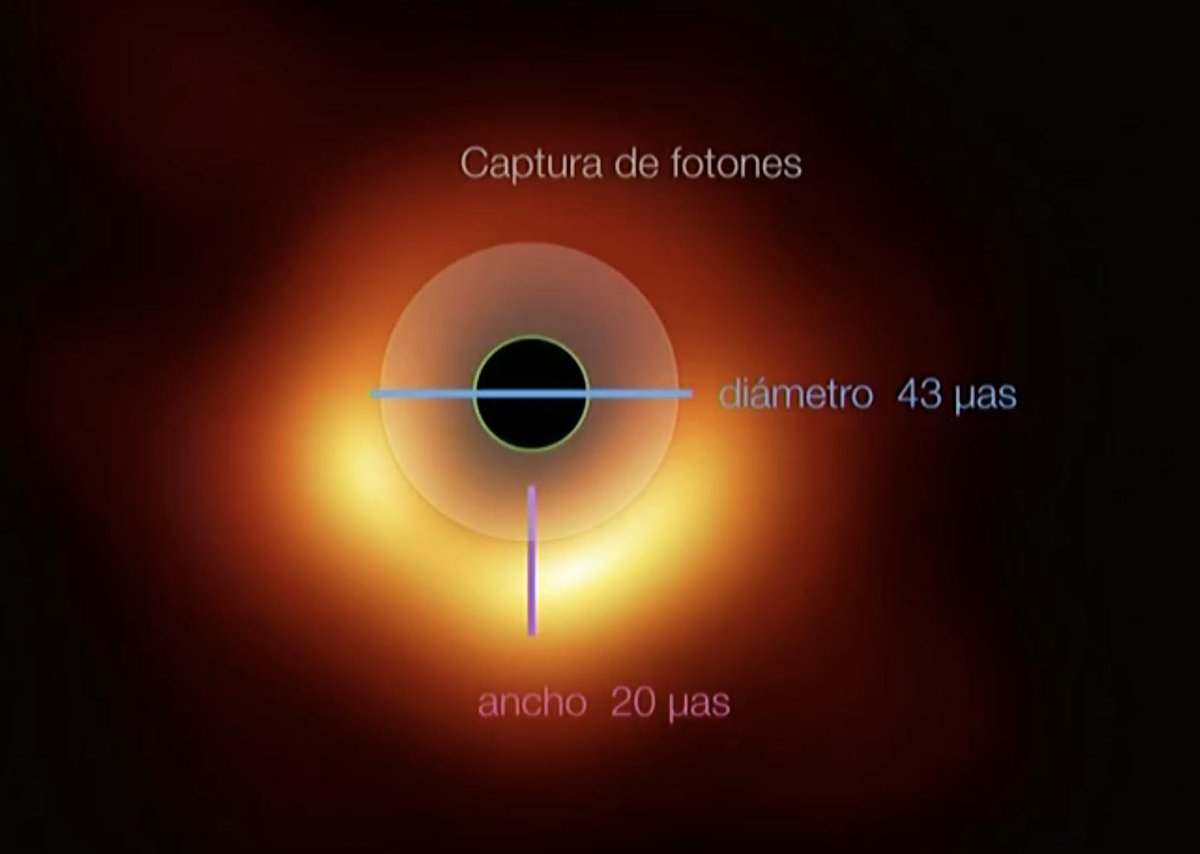
El primer agujero negro retratado, explicado
El primer agujero negro retratado, explicado 
Esta imagen largamente buscada proporciona la evidencia más sólida hasta la fecha de la existencia de agujeros negros supermasivos y abre una nueva ventana al estudio de los agujeros negros, sus horizontes de eventos y la gravedad, según destaca en un comunicado el proyecto EHT.
“Hemos tomado la primera fotografía de un agujero negro”, proclamó el director de proyectos de EHT, Sheperd S. Doeleman, del Center for Astrophysics Harvard Smithsonian. Los agujeros negros son objetos cósmicos extraordinarios con masas enormes pero tamaños extremadamente compactos. La presencia de estos objetos afecta su entorno de manera extrema, deformando el espacio-tiempo y sobrecalentando cualquier material circundante.
“Si estamos inmersos en una región brillante, como un disco de gas brillante, esperamos que un agujero negro cree una región oscura similar a una sombra, algo predicho por la relatividad general de Einstein que nunca hemos visto antes”, explicó el presidente del Consejo Científico del EHT, Heino Falcke, de la Universidad de Radboud, Países Bajos. “Esta sombra, causada por la inclinación gravitacional y la captura de luz por el horizonte de sucesos, revela mucho sobre la naturaleza de estos objetos fascinantes y nos permitió medir la enorme masa del agujero negro de M87”.


It’s Finally here. The First Ever Image of a Black Hole


We have taken the first picture of a black hole.

EHT project director Sheperd S. Doeleman of the Center for Astrophysics | Harvard & Smithsonian.
What was once un-seeable can now be seen. Black holes, those difficult-to-understand singularities that may reside at the center of every galaxy, are becoming seeable. The Event Horizon Telescope (EHT) has revealed the first-ever image of a black hole, and with this image, and all the science behind it, they may help crack open one of the biggest mysteries in the Universe.
The black hole in this image resides at the center of M87, a massive galaxy that’s in the Virgo cluster of galaxies. Called M87* (M87-star), it’s a behemoth, at about 6.5 billion times the mass of the Sun. M87* is about 55 million light years from Earth. For now we only have this picture of M87*, but pictures of our very own black hole, Sagittarius A* at the center of the Milky Way, are still coming.

This may be the worst kept secret of the past couple weeks. Ever since the EHT said they would be announcing some important results, the excitement has built.
This is an extraordinary scientific feat accomplished by a team of more than 200 researchers.

EHT project director Sheperd S. Doeleman of the Center for Astrophysics | Harvard & Smithsonian.
We have taken the first picture of a black hole,” said EHT project director Sheperd S. Doeleman of the Center for Astrophysics | Harvard & Smithsonian. “This is an extraordinary scientific feat accomplished by a team of more than 200 researchers.

The Event Horizon Telescope (EHT) — a planet-scale array of eight ground-based radio telescopes forged through international collaboration — was designed to capture images of a black hole. The first image is of M87* at the center of the M87 galaxy. Image Credit: EHT Collaboration.

We already knew, or were pretty sure we knew, what it would look like. Even a year ago, scientists at the EHT were pretty certain, and they released a simulated image of what this first-ever image of a black hole would look like. But with science, you don’t know until you know. That’s why this image is so important.

Simulated view of a black hole released by the EHT in April, 2017. Credit: Bronzwaer/Davelaar/Moscibrodzka/Falcke, Radboud University

The image matches with what astrophysicists theorized it would look like. This is a real feather in the cap for science, and shows the power of theory developed from evidence. It shows that even though black holes are mysterious, and that their ultimate nature is still unknowable at this moment in history, we can still nibble around the edges. Over time we can remove more and more of the mystery until we understand what remains.
“Once we were sure we had imaged the shadow, we could compare our observations to extensive computer models that include the physics of warped space, superheated matter and strong magnetic fields. Many of the features of the observed image match our theoretical understanding surprisingly well,” remarks Paul T.P. Ho, EHT Board member and Director of the East Asian Observatory [5]. “This makes us confident about the interpretation of our observations, including our estimation of the black hole’s mass.
The confrontation of theory with observations is always a dramatic moment for a theorist. It was a relief and a source of pride to realise that the observations matched our predictions so well,” elaborated EHT Board member Luciano Rezzolla of Goethe Universität, Germany.

An optical image of the M87 galaxy captured by the European Southern Observatory's Very Large Telescope. M87* lies at the very center of that bright mass.Image Credit: ESO
An optical image of the M87 galaxy captured by the European Southern Observatory’s Very Large Telescope. M87* lies at the very center of that bright mass. Image Credit: ESO

Black holes are extreme objects. They are massive, almost incomprehensibly massive, yet in terms of size they are tiny. Because of their extreme nature, they affect their environment in extreme way.
As they attract matter to themselves with their massive gravitational pull, that matter begins to rotate around the hole, forming a disc. The closer it gets to the black hole, the faster the matter rotates. It heats up, and emits energy we can see. This is the source of light that can be imaged, even though the singularity at the center of M87* can not be seen.
What can be seen is the shadow that the black hole casts on this light.

This artist’s impression depicts a rapidly spinning supermassive black hole surrounded by an accretion disc. This thin disc of rotating material consists of the leftovers of a Sun-like star which was ripped apart by the tidal forces of the black hole. Shocks in the colliding debris as well as heat generated in accretion led to a burst of light, resembling a supernova explosion.

If immersed in a bright region, like a disc of glowing gas, we expect a black hole to create a dark region similar to a shadow — something predicted by Einstein’s general relativity that we’ve never seen before,” explained chair of the EHT Science Council Heino Falcke of Radboud University, the Netherlands. “This shadow, caused by the gravitational bending and capture of light by the event horizon, reveals a lot about the nature of these fascinating objects and has allowed us to measure the enormous mass of M87’s black hole.


This artist’s impression depicts the black hole at the heart of the enormous elliptical galaxy Messier 87 (M87). This black hole was chosen as the object of paradigm-shifting observations by the Event Horizon Telescope. The superheated material surrounding the black hole is shown, as is the relativistic jet launched by M87’s black hole. 
ESO/M. Kornmesser
This artist’s impression depicts the black hole at the heart of the enormous elliptical galaxy Messier 87 (M87). This black hole was chosen as the object of paradigm-shifting observations by the Event Horizon Telescope. The superheated material surrounding the black hole is shown, as is the relativistic jet launched by M87’s black hole. 
ESO/M. Kornmesser

The EHT isn’t a single telescope. It’s more like a virtual telescope, and it’s more properly called a Very Long Baseline Interferometer. What that means is they’ve linked up radio antennae around the globe to observe the same object. This gives the telescope “high angular resolving power.” Basically, the bigger the ‘scope, the more detail we can see. And no telescope is as big as the Earth, except for the EHT. The extremely high resolving power of the EHT means it can see a credit card on the surface of the Moon.
The EHT combines the power of radio-telescope facilities in Hawaii, Mexico, high in the Chilean Atacama Desert, down in Antarctica, and other locations. The data they produce is taken to computing centers at the Max Planck Institute for radio astronomy and the MIT Haystack Observatory, where special atomic clocks are used to calibrate and combine the data, producing this image.
If one of humanity’s goals is to understand nature, then the people behind the Event Horizon Telescope are well on their way. The EHT isn’t done yet. There will be more science results coming from the over 200 researchers working on the project.


In anticipation of the first image of a black hole, Jordy Davelaar and colleagues built a virtual reality simulation of one of these fascinating astrophysical objects. Their simulation shows a black hole surrounded by luminous matter. This matter disappears into the black hole in a vortex-like way, and the extreme conditions cause it to become a glowing plasma. The light emitted is then deflected and deformed by the powerful gravity of the black hole. Image Credit: 
Jordy Davelaar et al./Radboud University/BlackHoleCam
In anticipation of the first image of a black hole, Jordy Davelaar and colleagues built a virtual reality simulation of one of these fascinating astrophysical objects. Their simulation shows a black hole surrounded by luminous matter. This matter disappears into the black hole in a vortex-like way, and the extreme conditions cause it to become a glowing plasma. The light emitted is then deflected and deformed by the powerful gravity of the black hole. Image Credit: 
Jordy Davelaar et al./Radboud University/BlackHoleCam

This first black hole image isn’t exactly a surprise, but the EHT may still reveal some surprising things about black holes.
The EHT is focused on two holes: M87* in Virgo, and Sagittarius A*, at the heart of our Milky Way galaxy. They represent two types of black holes. M87* emits jets of material, while Sag. A* doesn’t. We don’t why.
Images of Sag. A* are still coming, so stay tuned. Maybe the EHT will be able to answer why some black holes emit these relativistic jets, and why some don’t.
If you’re curious about black holes, and who isn’t, then the following video may contain some of the answers you’re looking for.


Captada una señal de ondas gravitacionales nunca vista

  Los detectores LIGO y Virgo captan dos choques de agujeros negros contra estrellas de neutrones, los astros más densos del universo. Dos d...