Mostrando entradas con la etiqueta exoplanets. Mostrar todas las entradas

jueves, 10 de agosto de 2017

Hubble Detects Exoplanet with Glowing Water Atmosphere


Artist's concept shows hot Jupiter WASP-121
This artist's concept shows hot Jupiter WASP-121b, which presents the best evidence yet of a stratosphere on an exoplanet.
Credits: Engine House VFX, At-Bristol Science Centre, University of Exeter

Artist's concept of planet's atmosphere
The top of the planet's atmosphere is heated to a blazing 4,600 degrees Fahrenheit (2,500 Celsius), hot enough to boil some metals.
Credits: NASA, ESA, and G. Bacon (STSci)
Scientists have discovered the strongest evidence to date for a stratosphere on a planet outside our solar system, or exoplanet. A stratosphere is a layer of atmosphere in which temperature increases with higher altitudes.
"This result is exciting because it shows that a common trait of most of the atmospheres in our solar system -- a warm stratosphere -- also can be found in exoplanet atmospheres," said Mark Marley, study co-author based at NASA's Ames Research Center in California's Silicon Valley. "We can now compare processes in exoplanet atmospheres with the same processes that happen under different sets of conditions in our own solar system."
Reporting in the journal Nature, scientists used data from NASA's Hubble Space Telescope to study WASP-121b, a type of exoplanet called a "hot Jupiter." Its mass is 1.2 times that of Jupiter, and its radius is about 1.9 times Jupiter's -- making it puffier. But while Jupiter revolves around our sun once every 12 years, WASP-121b has an orbital period of just 1.3 days. This exoplanet is so close to its star that if it got any closer, the star's gravity would start ripping it apart. It also means that the top of the planet's atmosphere is heated to a blazing 4,600 degrees Fahrenheit (2,500 Celsius), hot enough to boil some metals. The WASP-121 system is estimated to be about 900 light years from Earth – a long way, but close by galactic standards.
Previous research found possible signs of a stratosphere on the exoplanet WASP-33b as well as some other hot Jupiters. The new study presents the best evidence yet because of the signature of hot water molecules that researchers observed for the first time.
“Theoretical models have suggested stratospheres may define a distinct class of ultra-hot planets, with important implications for their atmospheric physics and chemistry,” said Tom Evans, lead author and research fellow at the University of Exeter, United Kingdom. “Our observations support this picture.”

This 360° animation depicts planet WASP-121b; an exoplanet with an atmosphere of glowing water. With an atmosphere hot enough to boil iron, WASP-121b is a type of exoplanet known as a 'hot Jupiter'. The planet orbits closely to it's host star, located in the constellation of 'Puppis', about 900 light years away from Earth.
To study the stratosphere of WASP-121b, scientists analyzed how different molecules in the atmosphere react to particular wavelengths of light, using Hubble's capabilities for spectroscopy.  Water vapor in the planet's atmosphere, for example, behaves in predictable ways in response to certain wavelengths of light, depending on the temperature of the water.
Starlight is able to penetrate deep into a planet's atmosphere, where it raises the temperature of the gas there. This gas then radiates its heat into space as infrared light. However, if there is cooler water vapor at the top of the atmosphere, the water molecules will prevent certain wavelengths of this light from escaping to space. But if the water molecules at the top of the atmosphere have a higher temperature, they will glow at the same wavelengths.
"The emission of light from water means the temperature is increasing with height," said Tiffany Kataria, study co-author based at NASA's Jet Propulsion Laboratory, Pasadena, California. "We're excited to explore at what longitudes this behavior persists with upcoming Hubble observations."  
The phenomenon is similar to what happens with fireworks, which get their colors from chemicals emitting light. When metallic substances are heated and vaporized, their electrons move into higher energy states. Depending on the material, these electrons will emit light at specific wavelengths as they lose energy: sodium produces orange-yellow and strontium produces red in this process, for example. The water molecules in the atmosphere of WASP-121b similarly give off radiation as they lose energy, but in the form of infrared light, which the human eye is unable to detect.
In Earth's stratosphere, ozone gas traps ultraviolet radiation from the sun, which raises the temperature of this layer of atmosphere. Other solar system bodies have stratospheres, too; methane is responsible for heating in the stratospheres of Jupiter and Saturn's moon Titan, for example.
In solar system planets, the change in temperature within a stratosphere is typically around 100 degrees Fahrenheit (about 56 degrees Celsius). On WASP-121b, the temperature in the stratosphere rises by 1,000 degrees (560 degrees Celsius). Scientists do not yet know what chemicals are causing the temperature increase in WASP-121b's atmosphere. Vanadium oxide and titanium oxide are candidates, as they are commonly seen in brown dwarfs, "failed stars" that have some commonalities with exoplanets. Such compounds are expected to be present only on the hottest of hot Jupiters, as high temperatures are needed to keep them in a gaseous state.
"This super-hot exoplanet is going to be a benchmark for our atmospheric models, and it will be a great observational target moving into the Webb era," said Hannah Wakeford, study co-author who worked on this research while at NASA's Goddard Space Flight Center, Greenbelt, Maryland.
The Hubble Space Telescope is a project of international cooperation between NASA and ESA (European Space Agency). NASA's Goddard Space Flight Center in Greenbelt, Maryland, manages the telescope. The Space Telescope Science Institute (STScI) in Baltimore, Maryland, conducts Hubble science operations. STScI is operated for NASA by the Association of Universities for Research in Astronomy, Inc., in Washington. Caltech manages JPL for NASA.
For more information about Hubble, visit:
For more information about exoplanets, visit:
Elizabeth Landau
Jet Propulsion Laboratory, Pasadena, Calif.
818-354-6425
elizabeth.landau@jpl.nasa.gov
Ray Villard
Space Telescope Science Institute, Baltimore, Maryland
410-338-4514
villard@stsci.edu
2017-204     
Last Updated: Aug. 4, 2017
Editor: Tony Greicius
Fuente: https://www.nasa.gov/feature/jpl/hubble-detects-exoplanet-with-glowing-water-atmosphere

domingo, 13 de febrero de 2011

Kepler Discovers First Earth Sized Planets inside Habitable Zone


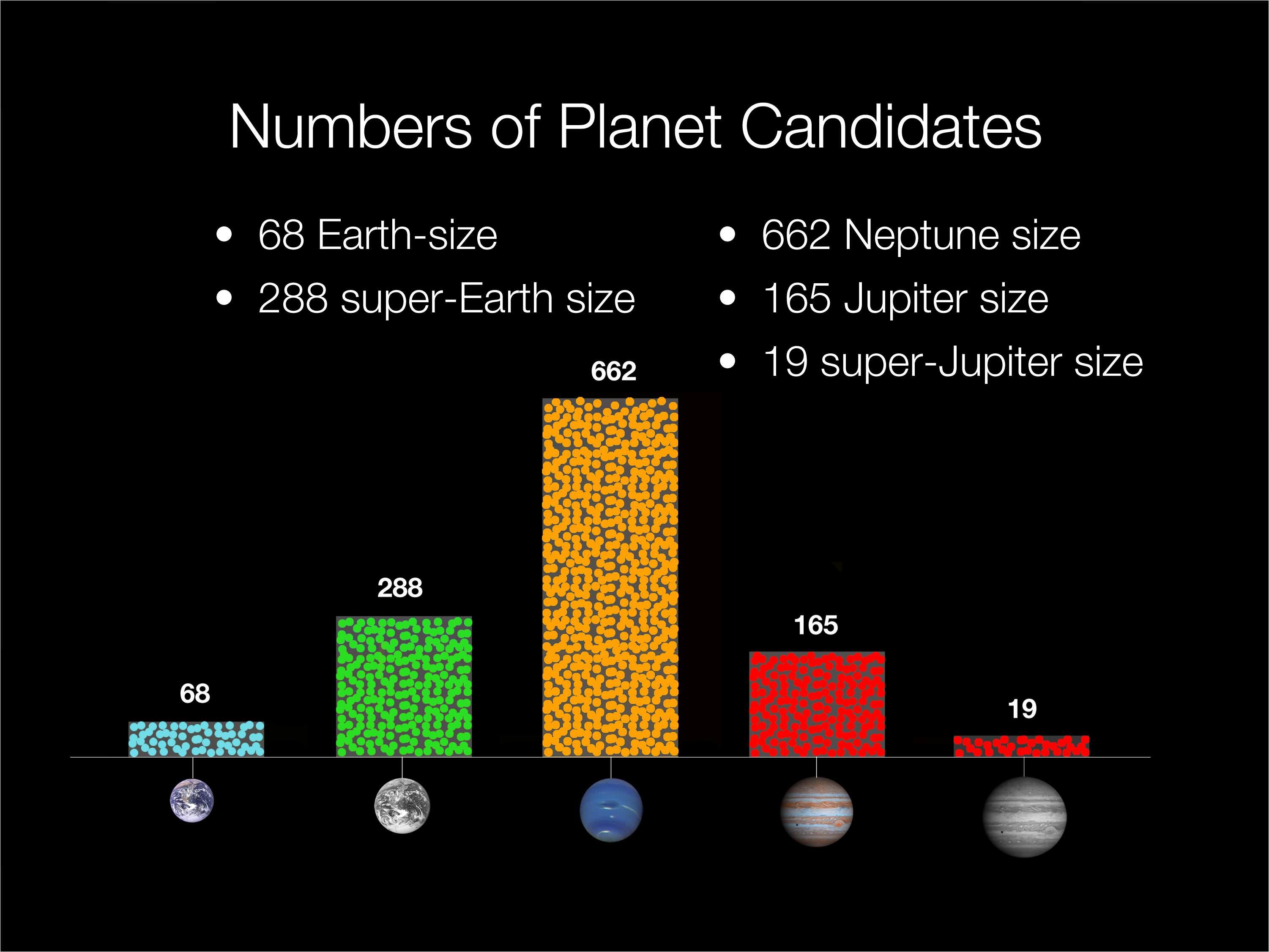
Keplers 1200 Planet candidates by size and location
on the Photometer array of 42 CCD elements. Credit: NASA/Wendy Stenzel
As the number of Pale Blue Dots increase, so do the chances for finding life on a Second Earth
Updated with more Videos and photos below

With the startling new finding of dozens of Earth-sized extrasolar planets, NASA’s Kepler planet hunting space telescope has just revolutionized our understanding of Earths place in the Universe and the search for Extraterrestrial Life. And the historic science discovery is based on data collected in just the first few months of operation of the powerful telescope as it scans only a tiny portion of the sky.
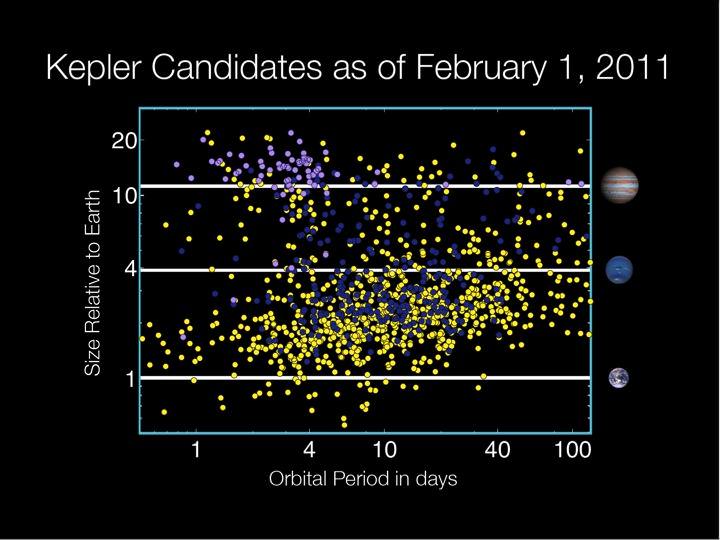
The discovery of 1235 new extrasolar planet candidates was announced today (Feb.2) by NASA and Kepler scientists at a media briefing. 68 of these planet candidates are Earth-sized. Another 288 are Super-Earth-size, 662 are Neptune-size and 165 are Jupiter-size. Most of these candidates orbit stars like our sun.
Even more significant is that 54 of the planet candidates are located within the ‘habitable zone’ of their host stars and 5 of those are Earth-sized. Before today we knew of exactly ZERO Earth-sized planets within the habitable zone. Now there are 5.
Finding a ‘Pale Blue Dot’ or ‘Second Earth’ inside a habitable zone that harbors water and environmental conditions that can support life is the ‘Holy Grail’ of science.
Are We Alone ?
“We went from zero to 68 Earth-sized planet candidates and zero to 54 candidates in the habitable zone – a region where liquid water could exist on a planet’s surface. Some candidates could even have moons with liquid water,” said William Borucki of NASA’s Ames Research Center, Moffett Field, Calif.. Borucki is the science principal investigator for NASA’s Kepler mission.
“Five of the planetary candidates are both near Earth-size and orbit in the habitable zone of their parent stars.”
Earth-sized water worlds are the most conducive to the formation and evolution of alien life forms. Water is an essential prerequisite for life as we know it.
“Kepler’s blown the lid off everything we know about extrasolar planets,” said Debra Fischer, professor of Astronomy at Yale University, New Haven, Conn
Kepler's over 1200 planet candidates as of Feb. 1, 2011. Credit: NASA/Wendy Stenzel
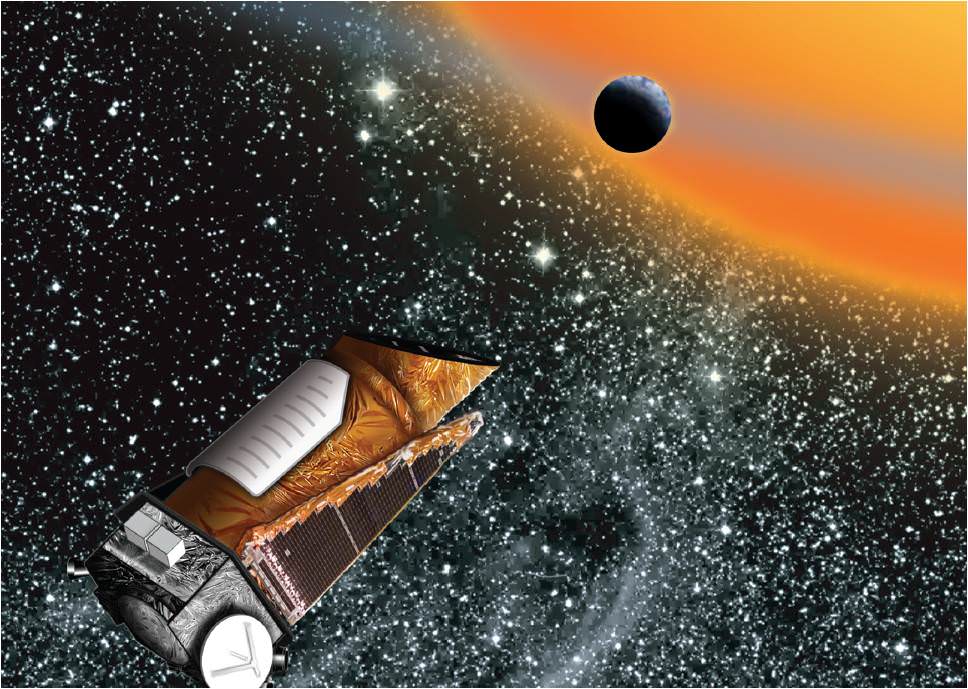
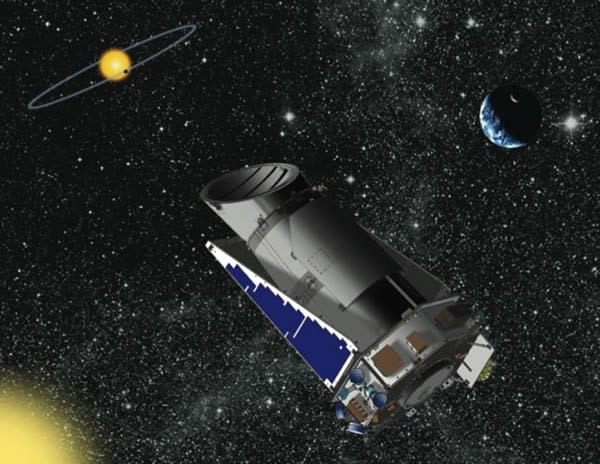
Kepler is the first NASA mission capable of finding Earth-size planets in or near the habitable zones around their parent stars. The mission uses the transit method to detect the tell tale signatures of planets. The goal is to determine how common are planets the size of Earth orbiting inside the habitable zone of stars like our sun.
Kepler measures the miniscule decreases in the brightness of stars caused by planets crossing in front of them and blocking the starlight. Imagine calculating the difference in light transmission caused by a flea sitting on a cars headlight.

Follow up observations over a period of several years will be required to confirm these results, the scientists explained. Astronomers expect that over 80% of the candidate planets will be positively confirmed as real planets by utilizing ground based observatories and the Spitzer Space Telescope.
For an Earth-sized planet orbiting a sun-like star inside the habitable zone, transits occur about once per year. Since three transits are required to verify a planets status, it will therefore take about three years to reach a definitive conclusion.
These remarkable new planet discoveries are based on observations from only the first four months of Kepler’s telescopic operations – May 12, 2009 to Sept. 17, 2009. The space based observatory continuously monitors more than 156,000 stars using 42 CCD detectors with a field of view that covers only 1/400 of the sky.
“Kepler is making good progress towards its goals,” said Borucki
“We have found over twelve hundred candidate planets – that’s more than all the people have found so far in history.”
“Imagine if we could look wider. Kepler looks at one 400th of the sky. If we had 400 of these fields of view, we’d see 400 times that number of candidates. We would see 400,000 candidate planets.”
Keplers over 1200 Planet candidates sorted by size
“The fact that we’ve found so many planet candidates in such a tiny fraction of the sky suggests there are countless planets orbiting stars like our sun in our galaxy,” Borucki amplified. “Our results indicate there must be millions of planets orbiting the stars that surround our sun.”
“If we find that Earth’s are common in the habitable zones of stars, very likely that means life is common around these stars.”
“Kepler has shown that planetary systems like our own are common,” said Debra Fischer.
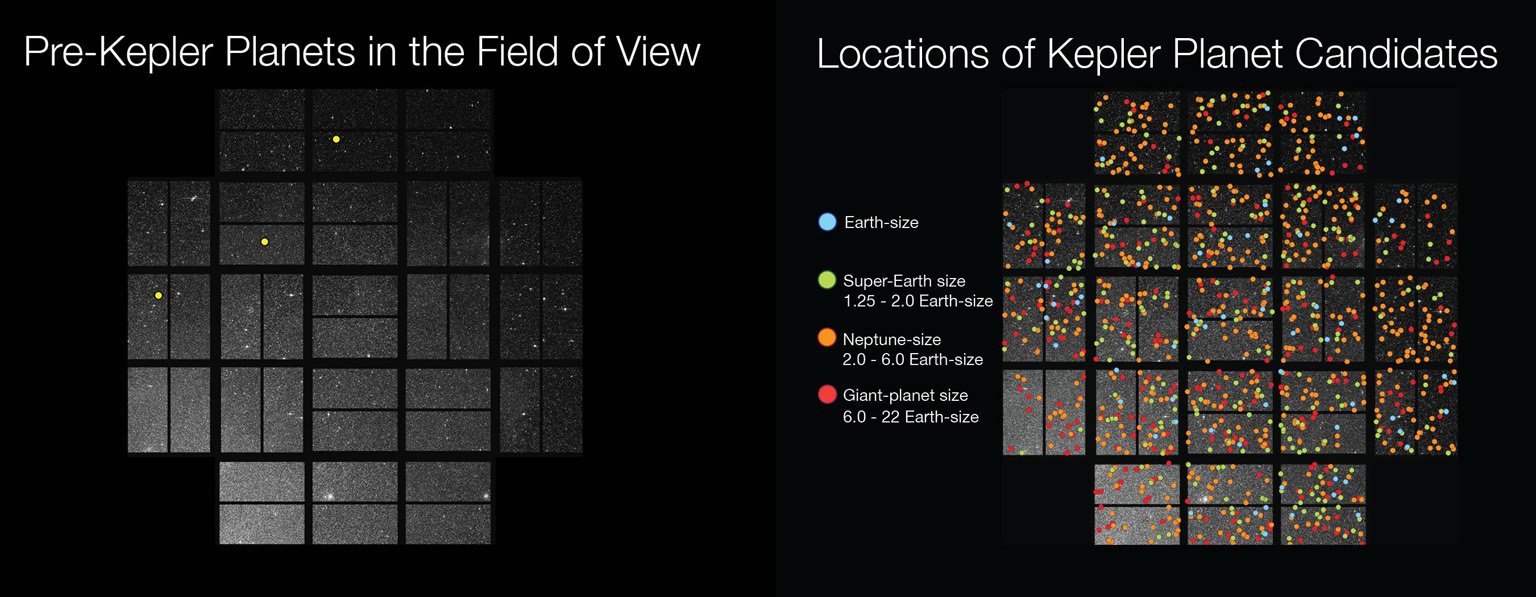
Planets in Keplers Field of View.
Before and after the discovery of over 1200 planet candidates by NASA’s Kepler Space Telescope.
“The search for planets is motivated by the search for life,” Fischer added.
“We have allowed the public to participate though the website Planethunters.org,” she added. “And now we have over 16,000 dedicated users. The public is excited to be a part of research and history.”
“Thanks to Kepler for this treasure chest of data!” Fisher concluded.
Kepler is just the first step in finding Earth sized and Earth like planets. “We are building the foundation for future generations of explorers,” said Borucki.
“Future missions will be developed to study the composition of planetary atmospheres to determine if they are compatible with the presence of life. The design for these missions depends on Kepler finding whether Earth-size planets in the habitable zone are common or rare.”
The first planets beyond our solar system were discovered in 1995. Up to today there were just over 500 known extrasolar planets.
Kepler now has 15 confirmed extrasolar planet discoveries and over 1200 possible candidates.
In January 2011, Kepler confirmed the discovery of its first rocky planet, named Kepler-10b. The molten world measures just 1.4 times the size of Earth and is the smallest planet ever discovered outside our solar system.
NASA’s Kepler spacecraft was launched on March 6, 2009 from Launch Complex 17-B atop a Delta II rocket at Cape Canaveral Air Force Station in Florida. See spacecraft and launch photos below
Kepler’s science operations are currently funded for three and one half years of operations until November 2012. The mission’s lifetime – and its goal of discovering multitudes of new planets as small as Earth – can be extended if NASA funding is approved by Congress and the President.
William Borucki – Explains Keplers Discovery of Earth Sized Planets
Science principal investigator for NASA’s Kepler mission, NASA’s Ames Research Center
Video Caption: NASA’s Kepler mission has discovered its first Earth-size planet candidates and its first candidates in the habitable zone, a region where liquid water could exist on a planet’s surface. Five of the potential planets are near Earth-size and orbit in the habitable zone of smaller, cooler stars than our sun.
Kepler also found six confirmed planets orbiting a sun-like star, Kepler-11. This is the largest group of transiting planets orbiting a single star yet discovered outside our solar system. Located approximately 2,000 light years from Earth, Kepler-11 is the most tightly packed planetary system yet discovered. All six of its confirmed planets have orbits smaller than Venus, and five of the six have orbits smaller than Mercury’s.

http://www.universetoday.com 

Captada una señal de ondas gravitacionales nunca vista

  Los detectores LIGO y Virgo captan dos choques de agujeros negros contra estrellas de neutrones, los astros más densos del universo. Dos d...