Mostrando entradas con la etiqueta neutron stars. Mostrar todas las entradas

viernes, 25 de octubre de 2019

Astronomers See Strontium in the Kilonova Wreckage, Proof that Neutron Star Collisions Manufacture Heavy Elements in the Universe


Astronomers have spotted Strontium in the aftermath of a collision between two neutron stars. This is the first time a heavy element has ever been identified in a kilonova, the explosive aftermath of these types of collisions. The discovery plugs a hole in our understanding of how heavy elements form.
In 2017, the Laser Interferometer Gravitational-Wave Observatory (LIGO) and the European VIRGO observatory detected gravitational waves coming from the merger of two neutron stars. The merger event was named GW170817, and it was about 130 million light years away in the galaxy NGC 4993.

The resulting kilonova is called AT2017gfo, and the European Southern Observatory (ESO) pointed several of their telescopes at it to observe it in different wavelengths. In particular, they pointed the Very Large Telescope (VLT) and its X-shooter instrument at the kilonova.

This chart shows the sprawling constellation of Hydra (The Female Sea Serpent), the largest and longest constellation in the sky. Most stars visible to the naked eye on a clear dark night are shown. The red circle marks the position of the galaxy NGC 4993, which became famous in August 2017 as the site of the first gravitational wave source that was also identified in light visible light as the kilonova GW170817. NGC 4993 can be seen as a very faint patch with a larger amateur telescope. Image Credit:  ESO, IAU and Sky & Telescope
This chart shows the sprawling constellation of Hydra (The Female Sea Serpent), the largest and longest constellation in the sky. Most stars visible to the naked eye on a clear dark night are shown. The red circle marks the position of the galaxy NGC 4993, which became famous in August 2017 as the site of the first gravitational wave source that was also identified in light visible light as the kilonova GW170817. NGC 4993 can be seen as a very faint patch with a larger amateur telescope. Image Credit: ESO, IAU and Sky & Telescope
The X-shooter is a multi-wavelength spectrograph that observes in Ultraviolet B (UVB,) visible light, and Near Infrared (NIR.) Initially, X-shooter data suggested that there were heavier elements present in the kilonova. But until now, they couldn’t identify individual elements.
“This is the final stage of a decades-long chase to pin down the origin of the elements.”
Darach Watson, Lead Author, University of Copenhagen.
These new results are presented in a new study titled “Identification of strontium in the merger of two neutron stars.” The lead author is Darach Watson from the University of Copenhagen in Denmark. The paper was published in the journal Nature on 24 October 2019.
“By reanalysing the 2017 data from the merger, we have now identified the signature of one heavy element in this fireball, strontium, proving that the collision of neutron stars creates this element in the Universe,” said Watson in a press release.

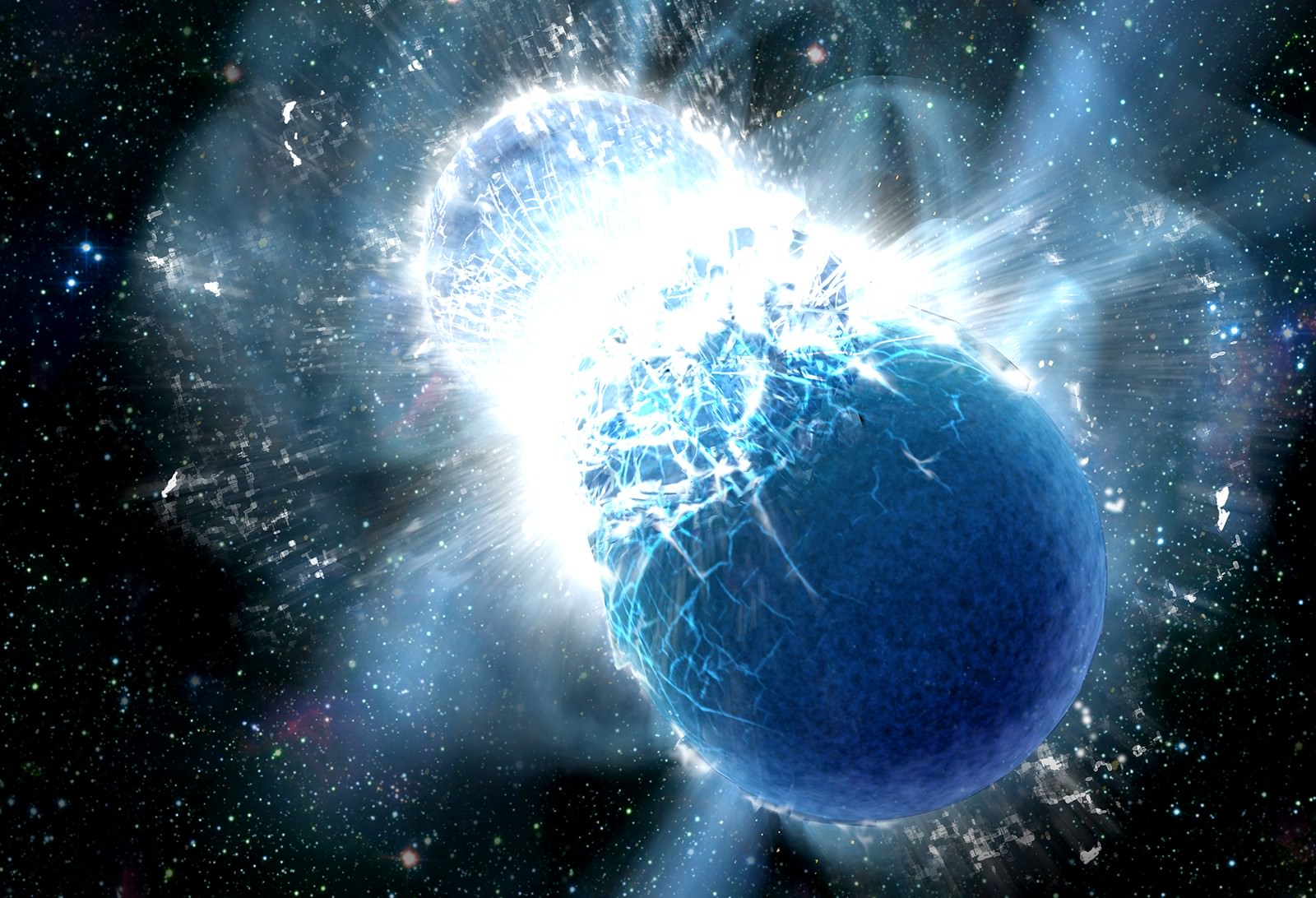
This artist’s impression shows two tiny but very dense neutron stars merging and exploding as a kilonova. Such objects are the main source of very heavy chemical elements, such as gold and platinum, in the Universe. The detection of one element, strontium (Sr), has now been confirmed using data from the X-shooter instrument on ESO’s Very Large Telescope.
The forging of the chemical elements is called nucleosynthesis. Scientists have known about it for decades. We know that elements form in supernovae, in the outer layers of aging stars, and in regular stars. But there’s been a gap in our understanding when it comes to neutron capture, and how heavier elements are formed. According to Watson, this discovery fills that gap.
“This is the final stage of a decades-long chase to pin down the origin of the elements,” says Watson. “We know now that the processes that created the elements happened mostly in ordinary stars, in supernova explosions, or in the outer layers of old stars. But, until now, we did not know the location of the final, undiscovered process, known as rapid neutron capture, that created the heavier elements in the periodic table.”
There are two types of neutron capture: rapid and slow. Each type of neutron capture is responsible for the creation of about half of the elements heavier than iron. Rapid neutron capture allows an atomic nucleus to capture neutrons quicker than it can decay, creating heavy elements. The process was worked out decades ago, and circumstantial evidence pointed to kilonovae as the likely place for the rapid neutron capture process to take place. But it was never observed at an astrophysical site, until now.

This animation is based on a series of spectra of the kilonova in NGC 4993 observed by the X-shooter instrument on ESO’s Very Large Telescope in Chile. They cover a period of 12 days after the initial explosion on 17 August 2017. The kilonova is very blue initially but then brightens in the red and fades.
Credit:ESO/E. Pian et al./S. Smartt & ePESSTO/L. Calçada
Stars are hot enough to produce many of the elements. But only the most extreme hot environments can create heavier elements like Strontium. Only those environments, like this kilonova, have enough free neutrons around. In a kilonova, atoms are constantly bombarded by massive numbers of neutrons, allowing the rapid neutron capture process to create the heavier elements.
“This is the first time that we can directly associate newly created material formed via neutron capture with a neutron star merger, confirming that neutron stars are made of neutrons and tying the long-debated rapid neutron capture process to such mergers,” says Camilla Juul Hansen from the Max Planck Institute for Astronomy in Heidelberg, who played a major role in the study.
Even though the X-shooter data has been around for a couple years, astronomers weren’t certain that they were seeing strontium in the kilonova. They thought they were seeing it, but couldn’t be sure right away. Our understanding of kilonovae and neutron star mergers is far from complete. There are complexities in the X-shooter spectra of the kilonova that had to be worked through, specifically when it comes to identifying the spectra of heavier elements.

On 17 August 2017, the Laser Interferometer Gravitational-Wave Observatory (LIGO) and the Virgo Interferometer both detected gravitational waves from the collision between two neutron stars. Within 12 hours observatories had identified the source of the event within the lenticular galaxy NGC 4993, shown in this image gathered with the NASA/ESA Hubble Space Telescope. The associated stellar flare, a kilonova, is clearly visible in the Hubble observations. This is the first time the optical counterpart of a gravitational wave event was observed. Hubble observed the kilonova gradually fading over the course of six days, as shown in these observations taken in between 22 and 28 August (insets). By ESA/Hubble, CC BY 4.0, https://commons.wikimedia.org/w/index.php?curid=63442000
“We actually came up with the idea that we might be seeing strontium quite quickly after the event. However, showing that this was demonstrably the case turned out to be very difficult. This difficulty was due to our highly incomplete knowledge of the spectral appearance of the heavier elements in the periodic table,” says University of Copenhagen researcher Jonatan Selsing, who was a key author on the paper. 
Up until now, rapid neutron capture was much debated, but never observed. This work fills in one of the holes in our understanding of nucleosynthesis. But it goes further than that. It confirms the nature of neutron stars.
After the neutron was discovered by James Chadwick in 1932, scientists proposed the existence of the neutron star. In a 1934 paper, astronomers Fritz Zwicky and Walter Baade advanced the view that “a super-nova represents the transition of an ordinary star into a neutron star, consisting mainly of neutrons. Such a star may possess a very small radius and an extremely high density.”
Three decades later, neutron stars were linked and identified with pulsars. But there was no way to prove that neutron stars were made of neutrons, because astronomers couldn’t obtain spectroscopic confirmation.
But this discovery, by identifying strontium, which could only have been synthesized under extreme neutron flux, proves that neutron stars are indeed made of neutrons. As the authors say in their paper, “The identification here of an element that could only have been synthesized so quickly under an extreme neutron flux, provides the first direct spectroscopic evidence that neutron stars comprise neutron-rich matter.”
This is important work. The discovery has plugged two holes in our understanding of the origin of elements. It confirms observationally what scientists knew theoretically. And that’s always good.

lunes, 23 de julio de 2018

Neutron Stars Collide


Shortly after 8:41 a.m. EDT on Aug. 17, 2017, Fermi's Gamma-ray Burst Monitor detected a pulse of high-energy light from a powerful explosion, which was immediately reported to astronomers around the globe as a short gamma-ray burst. Less that two seconds earlier, scientists at the National Science Foundation's Laser Interferometer Gravitational-wave Observatory (LIGO) detected gravitational-waves dubbed GW170817 from a pair of smashing super-dense stars, encouraging astronomers to look for the aftermath of the explosion. Shortly thereafter, the burst was detected as part of a follow-up analysis by ESA's (European Space Agency's) INTEGRAL satellite. NASA's Swift, Hubble, Chandra, and Spitzer missions, along with dozens of ground-based observatories, later captured the fading glow of the blast's expanding debris.
This is the first time scientists have conclusively detected light associated with a gravitational-wave event, thanks to two merging neutron stars in the galaxy NGC 4993, located about 130 million light-years from Earth. The figure shows an artist's impression of the aftermath of this merger.
Neutron stars are the crushed, leftover cores of massive stars that exploded as supernovae long ago. The merging stars likely had masses between 10 and 60 percent greater than that of our Sun, but they were no wider than Washington, D.C. The pair whirled around each other hundreds of times a second, producing gravitational-waves at the same frequency. As they drew closer and orbited faster, the stars eventually broke apart and merged, producing both a gamma-ray burst and a rarely seen flare-up called a "kilonova."
GW170817 showed astronomers that heavy elements found on Earth like gold, platinum, and uranium were likely produced kilonovae long ago.

viernes, 19 de enero de 2018

ASTRONOMERS SET THE LIMIT FOR JUST HOW MASSIVE NEUTRON STARS CAN BE

In February of 2016, scientists working at the Laser Interferometer Gravitational-Wave Observatory (LIGO) made history when they announced the first-ever detection of gravitational waves. Since that time, the study of gravitational waves has advanced considerably and opened new possibilities into the study of the Universe and the laws which govern it.
For example, a team from the University of Frankurt am Main recently showed how gravitational waves could be used to determine how massive neutron stars can get before collapsing into black holes. This has remained a mystery since neutron stars were first discovered in the 1960s. And with an upper mass limit now established, scientists will be able to develop a better understanding of how matter behaves under extreme conditions.
The study which describes their findings recently appeared in the scientific journal The Astrophysical Journal Letters under the title “Using Gravitational-wave Observations and Quasi-universal Relations to Constrain the Maximum Mass of Neutron Stars“. The study was led by Luciano Rezzolla, the Chair of Theoretical Astrophysics and the Director of the Institute for Theoretical Physics at the University of Frankfurt, with assistance provided by his students, Elias Most and Lukas Wei.
Collisions of neutron stars produce powerful gamma-ray bursts – and heavy elements like gold. Credit: Dana Berry, SkyWorks Digital, Inc.
For the sake of their study, the team considered recent observations made of the gravitational wave event known as  GW170817. This event, which took place on August 17th, 2017, was the sixth gravitational wave to be discovered by the Laser Interferometer Gravitational-wave Observatory (LIGO) and Virgo Observatory. Unlike previous events, this one was unique in that it appeared to be caused by the collision and explosion of two neutron stars.
And whereas other events occurred at distances of about a billion light years, GW170817 took place only 130 million light years from Earth, which allowed for rapid detection and research. In addition, based on modeling that was conducted months after the event (and using data obtained by the Chandra X-ray Observatory) the collision appeared to have left behind a black hole as a remnant.
The team also adopted a “universal relations” approach for their study, which was developed by researchers at Frankfurt University a few years ago. This approach implies that all neutron stars have similar properties which can be expressed in terms of dimensionless quantities. Combined with the GW data, they concluded that the maximum mass of non-rotating neutron stars cannot exceed 2.16 solar masses.

Artist’s impression of gravitational-wave emissions from a collapsing star. Credit: aktuelles.uni-frankfurt.de
As Professor Rezzolla explained in a University of Frankfurt press release:
“The beauty of theoretical research is that it can make predictions. Theory, however, desperately needs experiments to narrow down some of its uncertainties. It’s therefore quite remarkable that the observation of a single binary neutron star merger that occurred millions of light years away combined with the universal relations discovered through our theoretical work have allowed us to solve a riddle that has seen so much speculation in the past.”
This study is a good example of how theoretical and experimental research can coincide to produce better models ad predictions. A few days after the publication of their study, research groups from the USA and Japan independently confirmed the findings. Just as significantly, these research teams confirmed the studies findings using different approaches and techniques.
In the future, gravitational-wave astronomy is expected to observe many more events. And with improved methods and more accurate models at their disposal, astronomers are likely to learn even more about the most mysterious and powerful forces at work in our Universe.
Fuente: https://www.universetoday.com/138283/astronomers-set-limit-just-massive-neutron-stars-can/

Captada una señal de ondas gravitacionales nunca vista

  Los detectores LIGO y Virgo captan dos choques de agujeros negros contra estrellas de neutrones, los astros más densos del universo. Dos d...