sábado, 24 de febrero de 2018

Improved Hubble Yardstick Gives Fresh Evidence for New Physics in the Universe

Astronomers have used NASA's Hubble Space Telescope to make the most precise measurements of the expansion rate of the universe since it was first calculated nearly a century ago. Intriguingly, the results are forcing astronomers to consider that they may be seeing evidence of something unexpected at work in the universe.
That's because the latest Hubble finding confirms a nagging discrepancy showing the universe to be expanding faster now than was expected from its trajectory seen shortly after the big bang. Researchers suggest that there may be new physics to explain the inconsistency.
"The community is really grappling with understanding the meaning of this discrepancy," said lead researcher and Nobel Laureate Adam Riess of the Space Telescope Science Institute (STScI) and Johns Hopkins University, both in Baltimore, Maryland.

graphic showing galaxy, other data and stars on black
This illustration shows three steps astronomers used to measure the universe's expansion rate (Hubble constant) to an unprecedented accuracy, reducing the total uncertainty to 2.3 percent. The measurements streamline and strengthen the construction of the cosmic distance ladder, which is used to measure accurate distances to galaxies near to and far from Earth. The latest Hubble study extends the number of Cepheid variable stars analyzed to distances of up to 10 times farther across our galaxy than previous Hubble results.
Credits: NASA, ESA, A. Feild (STScI), and A. Riess (STScI/JHU)
Riess's team, which includes Stefano Casertano, also of STScI and Johns Hopkins, has been using Hubble over the past six years to refine the measurements of the distances to galaxies, using their stars as milepost markers. Those measurements are used to calculate how fast the universe expands with time, a value known as the Hubble constant. The team’s new study extends the number of stars analyzed to distances up to 10 times farther into space than previous Hubble results.
But Riess's value reinforces the disparity with the expected value derived from observations of the early universe's expansion, 378,000 years after the big bang — the violent event that created the universe roughly 13.8 billion years ago. Those measurements were made by the European Space Agency's Planck satellite, which maps the cosmic microwave background, a relic of the big bang. The difference between the two values is about 9 percent. The new Hubble measurements help reduce the chance that the discrepancy in the values is a coincidence to 1 in 5,000.
Planck's result predicted that the Hubble constant value should now be 67 kilometers per second per megaparsec (3.3 million light-years), and could be no higher than 69 kilometers per second per megaparsec. This means that for every 3.3 million light-years farther away a galaxy is from us, it is moving 67 kilometers per second faster. But Riess's team measured a value of 73 kilometers per second per megaparsec, indicating galaxies are moving at a faster rate than implied by observations of the early universe.
The Hubble data are so precise that astronomers cannot dismiss the gap between the two results as errors in any single measurement or method. "Both results have been tested multiple ways, so barring a series of unrelated mistakes," Riess explained, "it is increasingly likely that this is not a bug but a feature of the universe."
Explaining a Vexing Discrepancy
Riess outlined a few possible explanations for the mismatch, all related to the 95 percent of the universe that is shrouded in darkness. One possibility is that dark energy, already known to be accelerating the cosmos, may be shoving galaxies away from each other with even greater — or growing — strength. This means that the acceleration itself might not have a constant value in the universe but changes over time in the universe. Riess shared a Nobel Prize for the 1998 discovery of the accelerating universe.
Another idea is that the universe contains a new subatomic particle that travels close to the speed of light. Such speedy particles are collectively called "dark radiation" and include previously-known particles like neutrinos, which are created in nuclear reactions and radioactive decays. Unlike a normal neutrino, which interacts by a subatomic force, this new particle would be affected only by gravity and is dubbed a "sterile neutrino."
Yet another attractive possibility is that dark matter (an invisible form of matter not made up of protons, neutrons, and electrons) interacts more strongly with normal matter or radiation than previously assumed.
Any of these scenarios would change the contents of the early universe, leading to inconsistencies in theoretical models. These inconsistencies would result in an incorrect value for the Hubble constant, inferred from observations of the young cosmos. This value would then be at odds with the number derived from the Hubble observations.
Riess and his colleagues don't have any answers yet to this vexing problem, but his team will continue to work on fine-tuning the universe's expansion rate. So far, Riess's team, called the Supernova H0 for the Equation of State (SH0ES), has decreased the uncertainty to 2.3 percent. Before Hubble was launched in 1990, estimates of the Hubble constant varied by a factor of two. One of Hubble's key goals was to help astronomers reduce the value of this uncertainty to within an error of only 10 percent. Since 2005, the group has been on a quest to refine the accuracy of the Hubble constant to a precision that allows for a better understanding of the universe's behavior.
Building a Strong Distance Ladder
The team has been successful in refining the Hubble constant value by streamlining and strengthening the construction of the cosmic distance ladder, which the astronomers use to measure accurate distances to galaxies near to and far from Earth. The researchers have compared those distances with the expansion of space as measured by the stretching of light from receding galaxies. They then have used the apparent outward velocity of galaxies at each distance to calculate the Hubble constant.
But the Hubble constant's value is only as precise as the accuracy of the measurements. Astronomers cannot use a tape measure to gauge the distances between galaxies. Instead, they have selected special classes of stars and supernovae as cosmic yardsticks or milepost markers to precisely measure galactic distances.
Among the most reliable for shorter distances are Cepheid variables, pulsating stars that brighten and dim at rates that correspond to their intrinsic brightness. Their distances, therefore, can be inferred by comparing their intrinsic brightness with their apparent brightness as seen from Earth.

two galaxies with annotations
These Hubble Space Telescope images showcase two of the 19 galaxies analyzed in a project to improve the precision of the universe's expansion rate, a value known as the Hubble constant. The color-composite images show NGC 3972 (left) and NGC 1015 (right), located 65 million light-years and 118 million light-years, respectively, from Earth. The yellow circles in each galaxy represent the locations of pulsating stars called Cepheid variables.
Credits: NASA, ESA, A. Riess (STScI/JHU)
Astronomer Henrietta Leavitt was the first to recognize the utility of Cepheid variables to gauge distances in 1913. But the first step is to measure the distances to Cepheids independent of their brightness, using a basic tool of geometry called parallax. Parallax is the apparent shift of an object's position due to a change in an observer's point of view. This technique was invented by the ancient Greeks who used it to measure the distance from Earth to the Moon.
The latest Hubble result is based on measurements of the parallax of eight newly analyzed Cepheids in our Milky Way galaxy. These stars are about 10 times farther away than any studied previously, residing between 6,000 light-years and 12,000 light-years from Earth, making them more challenging to measure. They pulsate at longer intervals, just like the Cepheids observed by Hubble in distant galaxies containing another reliable yardstick, exploding stars called Type Ia supernovae. This type of supernova flares with uniform brightness and is brilliant enough to be seen from relatively farther away. Previous Hubble observations studied 10 faster-blinking Cepheids located 300 light-years to 1,600 light-years from Earth.
Scanning the Stars
To measure parallax with Hubble, the team had to gauge the apparent tiny wobble of the Cepheids due to Earth's motion around the Sun. These wobbles are the size of just 1/100 of a single pixel on the telescope's camera, which is roughly the apparent size of a grain of sand seen 100 miles away.
Therefore, to ensure the accuracy of the measurements, the astronomers developed a clever method that was not envisioned when Hubble was launched. The researchers invented a scanning technique in which the telescope measured a star's position a thousand times a minute every six months for four years.
The team calibrated the true brightness of the eight slowly pulsating stars and cross-correlated them with their more distant blinking cousins to tighten the inaccuracies in their distance ladder. The researchers then compared the brightness of the Cepheids and supernovae in those galaxies with better confidence, so they could more accurately measure the stars' true brightness, and therefore calculate distances to hundreds of supernovae in far-flung galaxies with more precision.
Another advantage to this study is that the team used the same instrument, Hubble's Wide Field Camera 3, to calibrate the luminosities of both the nearby Cepheids and those in other galaxies, eliminating the systematic errors that are almost unavoidably introduced by comparing those measurements from different telescopes.
"Ordinarily, if every six months you try to measure the change in position of one star relative to another at these distances, you are limited by your ability to figure out exactly where the star is," Casertano explained. Using the new technique, Hubble slowly slews across a stellar target, and captures the image as a streak of light. "This method allows for repeated opportunities to measure the extremely tiny displacements due to parallax," Riess added. "You're measuring the separation between two stars, not just in one place on the camera, but over and over thousands of times, reducing the errors in measurement."
The team's goal is to further reduce the uncertainty by using data from Hubble and the European Space Agency's Gaia space observatory, which will measure the positions and distances of stars with unprecedented precision. "This precision is what it will take to diagnose the cause of this discrepancy," Casertano said.
The team's results have been accepted for publication by The Astrophysical Journal.
The Hubble Space Telescope is a project of international cooperation between NASA and ESA (European Space Agency). NASA's Goddard Space Flight Center in Greenbelt, Maryland, manages the telescope. The Space Telescope Science Institute (STScI) in Baltimore conducts Hubble science operations. STScI is operated for NASA by the Association of Universities for Research in Astronomy, Inc., in Washington, D.C.
For more about Hubble, visit: www.nasa.gov/hubble
For additional imagery to this story, visit: https://media.stsci.edu/news_release/news/2018-12 

Donna Weaver / Ray Villard
Space Telescope Science Institute, Baltimore, Maryland
410-338-4493 / 410-338-4514
dweaver@stsci.edu / villard@stsci.edu
Last Updated: Feb. 22, 2018
Editor: Karl Hille

viernes, 23 de febrero de 2018

Researchers validate several fluctuation theorems for first time


February 23, 2018 by Kayla Zacharias, Purdue University

Researchers validate several fluctuation theorems for first time

Researchers experimentally tested the differential fluctuation theorem using an optically levitated nanosphere which can be trapped in air continuously for 65 weeks, acquiring large sets of data. Credit: Tongcang Li

Researchers at Purdue University have performed the first experimental tests of several fundamental theorems in thermodynamics, verifying the relationship between them and providing a better understanding of how nanoparticles behave under fluctuation

As a system gets smaller, fluctuations away from equilibrium begin to dominate its behavior. This makes the data from experiments in small systems, such as biological molecular motors and , messy and difficult to make sense of. Fluctuation theorems help researchers make sense of the fluctuations in these systems.
Fluctuation theorems are refinements of the second law of thermodynamics, which states that all kinds of energy in the material world disperses if it is not hindered from doing so.
A team of researchers from Purdue and Peking University, led by Tongcang Li, assistant professor of physics and astronomy at Purdue, tested the differential fluctuation theorem for work production and several other theorems. They levitated a nanoparticle in a vacuum chamber with a laser, using a tiny optical tweezer to measure instantaneous position and velocity. This mechanism allows them to trap the nanoparticle in air continuously for weeks or months and acquire large sets of data.
The research was published in Physical Review Letters.
More information: Thai M. Hoang et al. Experimental Test of the Differential Fluctuation Theorem and a Generalized Jarzynski Equality for Arbitrary Initial States, Physical Review Letters (2018). DOI: 10.1103/PhysRevLett.120.080602 


sábado, 10 de febrero de 2018

Roadster, Starman, Planeta Tierra

Créditos de imagen: SpaceX 
No os asustéis: tan sólo es un maniquí con un traje espacial llamado Starman.
Mientras la fase creciente de la Tierra iluminada del Sol se retira al fondo, Starman 
está cómodamente sentado al volante de un Tesla Roadster en esta imagen final de 
la carga útil lanzada por un cohete Falcon Heavy el 6 de febrero. Designado 
internacionalmente 2018-017A, el Roadster y Starman se dirigen al espacio más allá 
de la órbita de Marte. El exitoso cohete Falcon Heavy se ha convertido en el cohete en
 funcionamiento más potente y el Roadster uno de los cuatro coches eléctricos lanzados 
desde la Tierra. Los otros tres fueron lanzados a la Luna por cohetes Saturno V 
históricamente más potentes (pero no reutilizables). De todos modos, el Roadster de 
Starman es el único que en la calle se consideraría legal.

Fuente: http://observatorio.info/2018/02/roadster-starman-planeta-tierra/

miércoles, 31 de enero de 2018

Las primeras galaxias del Universo surgieron en forma similar a Vía Láctea


Un equipo de astrónomos observó un período que transcurrió poco después del Big Bang, y detectó torbellinos de gas en algunas de las primeras galaxias que se formaron en el Universo. Estas “recién nacidas” (observadas tales como eran hace unos 13.000 millones de años) surgieron formando vórtices similares a nuestra Vía Láctea.

El equipo internacional, encabezado por la Dra. Renske Smit, del Instituto Kavli de Cosmología (Universidad de Cambridge), usó el Atacama Large Millimeter/submillimeter Array (ALMA), ubicado en Chile, para observar por primera vez unas galaxias incubadoras de estrellas en el Universo distante. Los resultados de la investigación se publicaron en la revista Nature, y se presentarán en el congreso número 231 de la Sociedad Astronómica de Estados Unidos (AAS, en su sigla en inglés).

Como la luz de los objetos distantes tarda en alcanzar la Tierra, al observar objetos situados a miles de millones de años luz podemos observar el pasado y presenciar la formación de las primeras galaxias. Sin embargo, esa parte del Universo está llena de una densa “niebla” de gas de hidrógeno neutro que impide observar la formación de las primeras galaxias con telescopios ópticos.

Smit y sus colegas usaron ALMA para observar dos pequeñas galaxias recién nacidas tales como eran solo 800 millones de años después del Big Bang. Al analizar la “huella” espectral de la luz infrarroja lejana recabada por ALMA, pudieron calcular la distancia de las galaxias y, por primera vez, observar el movimiento interno del gas del que se alimentaron para crecer.

“Antes de ALMA, nunca habíamos presenciado la formación de galaxias con tanto detalle, y tampoco habíamos podido determinar el movimiento del gas en galaxias que se remontan a los inicios de la historia del Universo”, explica el Dr. Stefano Carniani, del Laboratorio Cavendish y el Instituto Kavli de Cosmología de Cambridge.

Los investigadores descubrieron que el gas presente en estas jóvenes galaxias rotaba formando un remolino, en forma similar a nuestra galaxia y otras galaxias más maduras observadas en períodos mucho más tardíos del Universo. Pese a ser relativamente pequeñas (cerca de cinco veces más pequeñas que la Vía Láctea), estas galaxias formaban estrellas a una mayor velocidad que otras galaxias jóvenes y, para sorpresa de los investigadores, eran menos caóticas de lo que se esperaba.

 “En el Universo joven, la gravedad generaba un rápido flujo de gas hacia las galaxias que las agitaba y desencadenaba la formación de numerosas estrellas. Y al estallar en violentas explosiones de supernova, estas estrellas agitaban el gas a su vez”, señala Smit, quien realiza un posdoctorado en el marco de una beca Rubicon en Cambridge, otorgada por la Organización Neerlandesa de Investigación Científica.

“Creíamos que las galaxias jóvenes serían más ‘desordenadas’ desde el punto de vista dinámico debido al caos generado por la explosión de estrellas jóvenes. Sin embargo, estas minigalaxias resultaron ser capaces de mantener cierto orden y parecen bien reguladas. A pesar de ser muy pequeñas, están en vías de alcanzar rápidamente la ‘madurez’ de galaxias como la nuestra”.

Los datos recabados por este proyecto allanan el camino para estudiar más a fondo las galaxias pertenecientes a los primeros miles de millones de años de las historia cósmica. 


OBSERVATORIO ALMA/DICYT

Fuente: http://elblogantares.blogspot.com.es/2018/01/las-primeras-galaxias-del-universo.html

viernes, 19 de enero de 2018

ASTRONOMERS SET THE LIMIT FOR JUST HOW MASSIVE NEUTRON STARS CAN BE

In February of 2016, scientists working at the Laser Interferometer Gravitational-Wave Observatory (LIGO) made history when they announced the first-ever detection of gravitational waves. Since that time, the study of gravitational waves has advanced considerably and opened new possibilities into the study of the Universe and the laws which govern it.
For example, a team from the University of Frankurt am Main recently showed how gravitational waves could be used to determine how massive neutron stars can get before collapsing into black holes. This has remained a mystery since neutron stars were first discovered in the 1960s. And with an upper mass limit now established, scientists will be able to develop a better understanding of how matter behaves under extreme conditions.
The study which describes their findings recently appeared in the scientific journal The Astrophysical Journal Letters under the title “Using Gravitational-wave Observations and Quasi-universal Relations to Constrain the Maximum Mass of Neutron Stars“. The study was led by Luciano Rezzolla, the Chair of Theoretical Astrophysics and the Director of the Institute for Theoretical Physics at the University of Frankfurt, with assistance provided by his students, Elias Most and Lukas Wei.
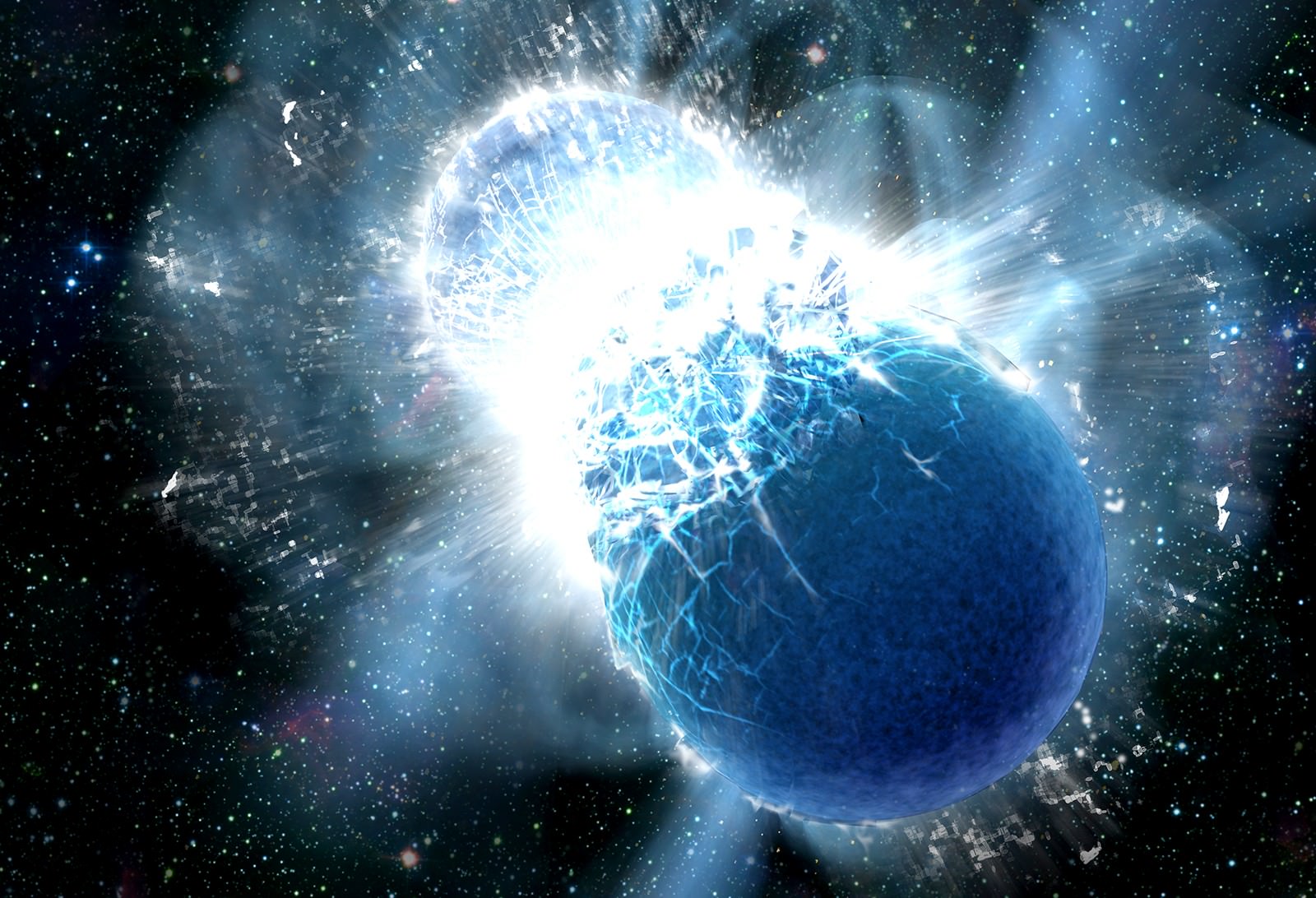
Collisions of neutron stars produce powerful gamma-ray bursts – and heavy elements like gold. Credit: Dana Berry, SkyWorks Digital, Inc.
For the sake of their study, the team considered recent observations made of the gravitational wave event known as  GW170817. This event, which took place on August 17th, 2017, was the sixth gravitational wave to be discovered by the Laser Interferometer Gravitational-wave Observatory (LIGO) and Virgo Observatory. Unlike previous events, this one was unique in that it appeared to be caused by the collision and explosion of two neutron stars.
And whereas other events occurred at distances of about a billion light years, GW170817 took place only 130 million light years from Earth, which allowed for rapid detection and research. In addition, based on modeling that was conducted months after the event (and using data obtained by the Chandra X-ray Observatory) the collision appeared to have left behind a black hole as a remnant.
The team also adopted a “universal relations” approach for their study, which was developed by researchers at Frankfurt University a few years ago. This approach implies that all neutron stars have similar properties which can be expressed in terms of dimensionless quantities. Combined with the GW data, they concluded that the maximum mass of non-rotating neutron stars cannot exceed 2.16 solar masses.

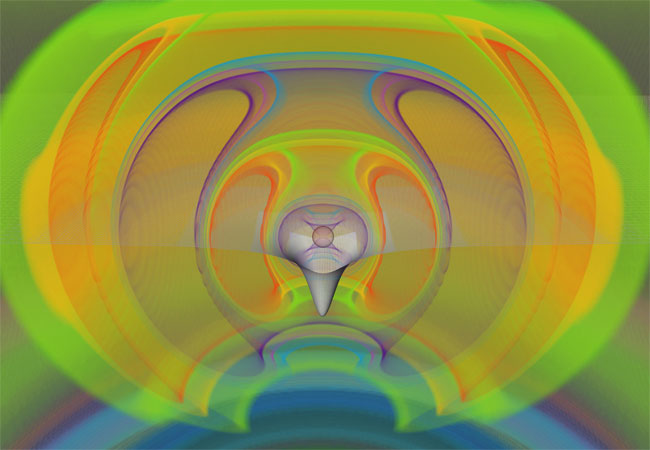
Artist’s impression of gravitational-wave emissions from a collapsing star. Credit: aktuelles.uni-frankfurt.de
As Professor Rezzolla explained in a University of Frankfurt press release:
“The beauty of theoretical research is that it can make predictions. Theory, however, desperately needs experiments to narrow down some of its uncertainties. It’s therefore quite remarkable that the observation of a single binary neutron star merger that occurred millions of light years away combined with the universal relations discovered through our theoretical work have allowed us to solve a riddle that has seen so much speculation in the past.”
This study is a good example of how theoretical and experimental research can coincide to produce better models ad predictions. A few days after the publication of their study, research groups from the USA and Japan independently confirmed the findings. Just as significantly, these research teams confirmed the studies findings using different approaches and techniques.
In the future, gravitational-wave astronomy is expected to observe many more events. And with improved methods and more accurate models at their disposal, astronomers are likely to learn even more about the most mysterious and powerful forces at work in our Universe.
Fuente: https://www.universetoday.com/138283/astronomers-set-limit-just-massive-neutron-stars-can/

domingo, 14 de enero de 2018

SETI quiere centrar su atención en un nuevo y misterioso objeto

La búsqueda de vida inteligente extraterrestre no para. Y a veces da sus frutos en el descubrimiento de interesantísimos nuevos objetos astronómicos. ¿Qué es FRB 121102 y por qué suscita tanta atención?


 SETI quiere centrar su atención en un nuevo y misterioso objeto


Nuevo año y nuevas noticias en la búsqueda de vida (inteligente) extraterrestre. Los esfuerzos SETI (del inglés, Search for ExtraTerrestrial Intelligence) por parte del equipo Breakthrough Listen de la Universidad de Berkeley están apuntando a una nueva y prometedora señal: la cononcida como FRB 121102, homónima del supuesto objeto que la produce. ¿Y por qué? Sus características, su emisión intermitente y rápida, y su distancia pronostican algo misterioso e interesantísimo. 

El misterioso objeto que emite hacia el universo 

Las recientes observaciones de un objeto distante que emite ráfagas intermitentes de ondas de radio ha llamado la atención de diversos científicos de todo el mundo. Estas señales son tan brillantes que pueden verse en todo el universo. Con estos datos, podemos conocer más sobre el lugar de donde vienen, pero no hemos conseguido aclarar el misterio de lo que los causa.

Ahora, utilizando el Telescopio Robert C. Byrd Green Bank para observar las ráfagas de radio rápidas producidas por FRB (fast radio burst) 121102, el equipo Breakthrough Listen pretende ahondar en las razones por las que se producen estos extraños estallidos.
 

Dichas señales, explican los investigadores, están casi 100% polarizadas linealmente, lo que indica que la fuente de las ráfagas está incrustada en fuertes campos magnéticos. Como los que se encuentran alrededor de un agujero negro masivo, por ejemplo. Ya, de por sí, esta característica es extraña.

Las ráfagas de radio son pulsos breves y brillantes de emisiones cuyas fuentes, hasta la fecha, eran desconocidas. El misterioso objeto FRB 121102 es el único que conoce como origen de dichas ráfagas: se han observado más de 200 estallidos de alta energía procedentes de esta fuente, que se encuentra en una galaxia enana a unos tres mil millones de años luz de la Tierra. ¿A qué se deben? 

La señal que parecía de otro mundo 

La noticia saltó a los medios el pasado septiembre cuando la Universidad de Harvard mostró la extraña señal al mundo: "Los estallidos de esta fuente nunca habían sido observados a esta frecuencia", explicaba Andrew Siemion, director del Centro de Investigación SETI de Berkeley y del programa Breakthrough Listen. El origen parece ser una galaxia enana a varios miles de años luz de aquí

En seguida la prensa se hizo con la voz: "¿Estamos ante una señal extraterrestre?", lo que atrajo la atención sobre el interesante descubrimiento. Pero esta señal no es nueva. Estos científicos se hicieron con las primeras señales allá por por 2012. Desde entonces, en busca de pistas de vida inteligente, FRB 121102 ha sido observada con detenimiento.

El origen de las FRB registradas es una galaxia enana con apenas el 1% de la masa de la Vía Láctea, situada a varios miles de millones de años luz de aquí. Desde su descubrimiento, las señales FRB grabadas se cuentan por cientos. ¿Sabemos por fin de dónde vienen? Los científicos creen que sí. 

Un magnetar junto al agujero 

Según el estudio, las mediciones confirman las observaciones de otros equipos de astrónomos: la polarización casi del 100% de las ráfagas de radio. Esto es algo verdaderamente extraño, y solo se ha visto en las emisiones de radio de los entornos magnéticos extremos alrededor de los agujeros negros masivos. Como los que se encuentran en los centros de las galaxias, por ejemplo.

Los científicos sugieren que estas ráfagas de radio rápidas podrían provenir de una estrella de neutrones giratoria altamente magnetizada, algo que conocemos como magnetar, situada cerca de agujero negro masivo que aún está creciendo a medida que el gas y el polvo son atrapados en él. 

 
Representación de un magnetar. Fuente: Nanda Rea/Jeff Michaud

Estas ráfagas oscilan entre los treinta microsegundos y los nueve milisegundos de duración, lo que indica que la fuente podría tener tan solo ¡diez kilómetros de diámetro! Este es el tamaño típico de una estrella de neutrones, lo que da pie a pensar en el magnetar. Pero la cosa no es tan sencilla.

"En este momento, no conocemos realmente el mecanismo. Todavía hay muchas preguntas sin contestar. Por ejemplo: ¿cómo puede una estrella de neutrones rotativa producir la gran cantidad de energía típica de un FRB?", planteaba Vishal Gajjar, investigador y parte del equipo Breakthrough Listen. Todavía queda mucho por descubrir. 

¿Y si fueran realmente extraterrestres? 

Otra posibilidad, aunque muy improbable, es que el FRB sea una señal de alta potencia de una civilización avanzada. Esta fue la hipótesis que dio pie a esta investigación. "No podemos descartar por completo la hipótesis extraterrestre para los FRB en general", afirmaba Gajjar. Breakthrough Listen ha registrado hasta la fecha datos de una docena de FRB, incluido el FRB 121102, y planea muestrear las treinta fuentes conocidas de ráfagas de radio rápidas. 

"Queremos una muestra completa para que podamos llevar a cabo nuestro análisis SETI estándar en busca de patrones de modulación o señales de banda estrecha", confirmaba. Los investigadores esperan encontrar así cualquier tipo de señal de información emitida que no esperamos de la naturaleza.

"Este resultado es una excelente demostración de las capacidades de la instrumentación Breakthrough Listen, [un equipo que está financiado de forma privada con más de 100 millones de dólares anuales] y las sinergias entre SETI y otros tipos de astronomía", explicaba Andrew Siemion. "Esperamos trabajar con la comunidad científica internacional para aprender más acerca de estas fuentes enigmáticas, 'perdidas' en mitad del universo".

Fuente: http://elblogantares.blogspot.com.es/2018/01/seti-quiere-centrar-su-atencion-en-un.html 

lunes, 1 de enero de 2018

Can Bose-Einstein condensates simulate cosmic inflation?

Cosmological inflation, first proposed by Alan Guth in 1979, describes a hypothetical period when the early Universe expanded faster than the speed of light. The model, which answers fundamental questions about the formation of the Universe we know today, has become central to modern cosmology, but many details remain uncertain. Now atomic physicists in the US have developed a laboratory analogue by shaking a Bose-Einstein condensate (BEC). The team's initial results suggest that the Universe may have remained quantum coherent throughout inflation and beyond. The researchers hope their condensate model may provide further insights into inflation in a more accessible system, however not everyone agrees on its usefulness.
Dynamical instability occurs in all sorts of physical systems that are out of equilibrium. A ball perched at the top of a hill, for example, may stay put for short time. But the tiniest perturbation will send the ball falling towards a lower-energy state at the bottom of the hill. Guth realized that a very short, very rapid period of expansion could occur if the Universe got stuck out of equilibrium around 10-35 s after the Big Bang, causing it to expand by a factor of around 1026 in a tiny fraction of a second. The details of the inflationary model have been revised many times, and numerous questions remain. "This is where I can contribute, even though I'm not a cosmologist," says Cheng Chin of the University of Chicago in Illinois: "We have only one Universe, so it becomes very hard to say whether our theories really capture the whole physics as we can't repeat the experiment."

Shake it up

Chin and colleagues created their model system by cooling 30,000 atoms in an optical trap into a BEC, in which all the atoms occupy a single quantum state. Initially, this BEC was sitting still in the centre of the trap. The researchers then began to shake the condensate by moving the trapping potential from side to side with increasing amplitude. This raised the energy of the state in which the condensate was stationary relative to the trapping potential. When the shaking amplitude was increased past a critical value, the energy of this "stationary" state became higher than the energy of two other states with the condensate oscillating in opposite directions inside the trap. The condensate therefore underwent a dynamical phase transition, splitting into two parts that each entered one of these two momentum states.
Between 20-30 ms after the phase transition, the researchers saw a clear interference pattern in the density of the condensate. This shows, says Chin, that the condensate had undergone a quantum coherent separation, with each atom entering a superposition of both momentum states. After this, the clear interference pattern died out. This later period corresponds, says Chin, to the period of cosmological relaxation in which, after inflation had finished, different parts of the Universe relaxed to their new ground states. More detailed analysis of the condensate in this phase showed that, although its quantum dynamics were more complicated – with higher harmonics of the oscillation frequencies becoming more prominent – the researchers' observations could not be described classically.
Chin says that cosmologists may find this observation interesting. Although "in principle, everything is quantum mechanical," he explains, the practical impossibility of performing a full quantum simulation of the Universe as its complexity grows leads cosmologists to fall back on classical models. "The value of our research is to try and point out that we shouldn't give up [on quantum simulation] that early," he says. "Even in inflation and the subsequent relaxation process, we have one concrete example to show that quantum mechanics and coherence still play a very essential role."

Inflated claims?

James Anglin of the University of Kaiserslautern in Germany is impressed by the research. "Understanding what happens to small initial quantum fluctuations after a big instability has saturated is an important and basic question in physics, and it really is an especially relevant question for cosmology," he explains. "The big difference, of course, is that the cosmic inflation scenario includes gravity as curved spacetime in general relativity, such that space expands enormously while the inflaton field [the field thought to drive inflation] finds its true ground state. A malicious critic might say that this experiment is a perfect analogue for cosmological inflation, except for the inflation part."
"This is indeed nice work," he concludes: "The language is simply a little bit inflated!" The research is described in Nature Physics.

About the author

Tim Wogan is a science writer based in the UK

Fuente: http://physicsworld.com/cws/article/news/2017/dec/28/can-bose-einstein-condensates-simulate-cosmic-inflation

domingo, 31 de diciembre de 2017

Descubiertas las estrellas masivas más pobres en metales conocidas hasta la fecha


El estudio del universo primitivo pasa necesariamente por entender el funcionamiento de las primeras estrellas que, según las simulaciones de formación estelar, pudieron ser muy masivas. En este contexto, comprender la evolución de las estrellas masivas es clave para interpretar los procesos de formación estelar que tuvieron lugar en las primeras épocas cósmicas. En ese periodo, el universo era todavía pobre en metales (para los astrofísicos, los elementos químicos que no sean hidrógeno y helio tienen la denominación de metales), de modo que para poder entender las épocas cósmicas pasadas es indispensable descubrir y caracterizar estrellas masivas en entornos que sean cada vez más pobres en metales. 
 
Imagen de la galaxia SagDIG. Se trata de una composición realizada con imágenes de archivo del Hubble Space Telescope (cámara ACS, con filtros F475Wazul y F814W-rojo). Las estrellas masivas detectadas están señaladas con cuadrados rojos. La línea roja de la zona inferior derecha, de 30 segundos de arco, indica la escala angular de la imagen. (© Adaptada de Hubble Heritage Team (AURA/STScI), Y.Momany (U. Padua) et al., ESA, NASA (2004).)

La investigadora del Centro de Astrobiología (CAB, CSIC-INTA) (España) Miriam García es la autora de un reciente estudio que presenta el descubrimiento de las primeras estrellas masivas en uno de estos entornos pobres en metales. Concretamente, este hallazgo ha tenido lugar en la galaxia enana irregular de Sagitario (SagDIG, por sus siglas en inglés Sagittarius Dwarf Irregular Galaxy), una galaxia que forma parte del Grupo Local y que está situada a 4,2 millones de años luz de la Tierra.

Las observaciones, que fueron realizadas con el Gran Telescopio Canarias (GTC) utilizando espectroscopía de baja resolución, desvelaron la presencia de cuatro estrellas masivas en SagDIG, tres azules de tipo OBA y una candidata a supergigante roja, que se han convertido en las estrellas masivas más pobres en metales conocidas en todo el Grupo Local. “Aún hay que obtener datos de mejor resolución espectral que nos permitan determinar la composición química de estas estrellas y confirmar su baja metalicidad”, asegura García, “pero, según la evidencia que hay en estos momentos, se trata de las estrellas masivas más pobres en metales que se conocen”.

Con este hallazgo se abre el camino hacia observaciones más profundas y exhaustivas de SagDIG que permitirá a los investigadores censar la población de estrellas masivas en su totalidad y determinar sus propiedades físicas, lo que podría llegar a convertir estas estrellas masivas pobres en metales, en palabras de García, “en el nuevo referente para el estudio del universo de baja metalicidad”.

Fuente: http://elblogantares.blogspot.com.es/2017/12/descubiertas-las-estrellas-masivas-mas.html

viernes, 8 de diciembre de 2017

Un agujero negro supermasivo nos permite saber cómo era el universo en su infancia

  • Científicos descubren el cuásar más lejano observado hasta la fecha.
  • Según publican en Nature, el objeto alberga un agujero negro que nos permite conocer cómo era el universo temprano.


Un equipo de científicos de la Institución Carnegie ha descubierto el cuásar más lejano detectado hasta la fecha. Los resultados, publicados en la revista Nature, nos permiten comprender cómo era el universo en su 'infancia'. La razón es que el cuásar se originó cuando el cosmos presentaba una antigüedad de tan solo 690 millones de años. “Nos ofrece una fotografía de cómo era el universo cuando este tenía solo 5% de su edad actual”, explica a Hipertextual Eduardo Bañados, primer autor del trabajo e investigador en el observatorio de la Institución Carnegie.

 El cuásar más distante observado hasta la fecha se originó cuando el universo tenía solo 690 millones de años

"Los cuásares son objetos muy poco comunes en el universo primitivo. Se estima que debe haber entre 20 a 100 cuásares tan luminosos y distantes como el descubierto por nuestro grupo", prosigue Bañados. Su equipo ha logrado detectar el cuásar más alejado encontrado nunca, al que han bautizado técnicamente como ULAS J1342+0928, y que presenta un corrimiento al rojo (redshift, en inglés) de 7,54, una medida que nos indica que está muy, muy lejos. "Hemos roto otra barrera de distancia al encontrar un objeto aún más lejano que el que ya conocíamos", explica a Hipertextual Ángel López-Sánchez, del Observatorio Astronómico Australiano y la Universidad de Macquarie, que no ha participado en el estudio publicado hoy en Nature. 

¿Qué es un cuásar y cómo se mide su lejanía? 

Aunque parezcan sinónimos, cuásar y agujero negro no son exactamente lo mismo. Según Bañados, podríamos definir cuásar como un agujero negro supermasivo activo en el centro de una galaxia muy masiva. Tal y como explica López-Sánchez a Hipertextual, los investigadores hablan de agujeros negros supermasivos para referirse a agujeros negros con más de un millón de veces la masa del Sol. Por ejemplo, en el caso del agujero negro del centro de nuestra galaxia, la Vía Láctea, hablamos de un agujero negro supermasivo que cuenta con 4,5 millones de masas solares, pero no es un cuásar. “Todas las galaxias poseen agujeros negros supermasivos. La cosa es saber si el agujero está activo o no”, comenta el investigador del Observatorio Astronómico Australiano.

Los científicos explican que un cuásar es un agujero negro supermasivo activo en el centro de una galaxia muy masiva

“A mí me gusta pensar esto como una analogía con los volcanes. Sabemos que existen volcanes activos e inactivos. Lo mismo ocurre con los agujeros negros supermasivos en el centro de las galaxias. Los que están activos, es decir, creciendo tragando materia, se llaman núcleos activos de galaxias (AGN, en inglés)”, sostiene Bañados. Los cuásares representan de hecho el caso extremo de los AGN: “la emisión de radiación del agujero negro es tan brutal que ‘enmascara’ a la galaxia entera”, apunta López-Sánchez. Estos objetos, recuerda Bañados, “generalmente viven en algunas de las galaxias más masivas que se conocen”. En definitiva, un cuásar sí es un agujero negro, pero no todos los agujeros negros son cuásares. Hasta la fecha solo ha sido posible detectar cuásares en el universo distante, no en el local; por otro lado, sabemos que estos objetos están en galaxias, una confirmación que llegó de la mano del telescopio Hubble. 

 
Ilustración sobre el hallazgo del cuásar más lejano encontrado hasta ahora. Crédito: Robin Dienel (Carnegie Institution for Science).

Antes de la publicación de este trabajo, la comunidad científica había logrado detectar un único cuásar, denominado ULAS J1120+0641, con un desplazamiento al rojo (redshift) superior a 7. La investigación liderada por la Institución Carnegie va un paso más allá, al haber encontrado un objeto que presenta un corrimiento al rojo de 7,54. “Para medir distancias cosmológicas los astrónomos utilizan una relación entre distancia y corrimiento al rojo. El desplazamiento al rojo es una medida de cómo la luz de un objeto se ‘estira’ al alejarse de nosotros debido a la expansión del universo”, explica Bañados. Este efecto es el mismo que ocurre cuando oímos la sirena de una ambulancia: a medida que el vehículo se aleja, iremos escuchando el sonido cada vez más grave. El objeto observado presenta un desplazamiento al rojo de 7,54, lo que significa que está muy, muy lejos 

“Usando esta medición empírica podemos luego usar nuestro conocimiento de cosmología e interpretar este desplazamiento al rojo [efecto Doppler] como una distancia. La luz que nos llega en estos momentos de este objeto ha estado viajando por más de 13 mil millones de años", asegura Bañados. El hecho de haber encontrado un cuásar con un corrimiento al rojo de 7,54 indica que dicho objeto se aleja de nosotros a 7,54 veces la velocidad de la luz, es decir, a 2,26 millones de kilómetros por seguro, comenta por su parte López-Sánchez. En otras palabras, determinar el desplazamiento al rojo del cuásar ULAS J1342+0928 nos ha permitido confirmar que el objeto está realmente lejos. 

 
Crédito: Jinyi Yang, Universidad de Arizona; Reidar Hahn, Fermilab; M. Newhouse NOAO/AURA/NSF. 

¿Por qué es importante el hallazgo? 

López-Sánchez destaca la importancia del descubrimiento por dos motivos. Por un lado, la detección a esa distancia de un agujero negro supermasivo de gran tamaño nos ayuda a entender cómo crecen los agujeros negros; por otro lado, las conclusiones del trabajo en Nature también permiten estudiar las propiedades derivadas del medio en el que se encuentra dicho objeto. Según Bañados, sus resultados “desafían varias de las teorías que existen [acerca del origen de estos objetos], ya que formar un agujero negro de 800 millones de masas solares en menos de 690 millones de años es muy difícil”. En el caso de que estos objetos estuvieran tragando materia a la velocidad más alta posible, llamada tasa de Eddington, “estos agujeros negros tendrían que formarse de ‘semillas’ extremadamente masivas”, sostiene. Los astrofísicos deben explicar ahora cómo es posible que se desarrollen estas masivas semillas o, por el contrario, sugerir una hipótesis diferente para comprender cómo se forman estos ‘monstruos’ en tan poco tiempo.

El descubrimiento del cuásar más distante nos permite comprender cómo crecen los agujeros negros o cuándo se encendieron las primeras estrellas

"Los agujeros negros crecen por fusión de objetos más pequeños, como las galaxias, y la fusión de agujeros negros es una fuente importante de ondas gravitatorias", señala López-Sánchez. El hallazgo presentado en Nature apoya en particular las hipótesis que defienden el rápido crecimiento de los agujeros negros supermasivos, además de ayudarnos a concretar mejor la fecha en la que se empezaron a encender las primeras estrellas en el universo. "Este cuásar está tan lejos que el universo sólo tenía unos 690 millones de años de edad. Los datos observacionales apoyan la hipótesis de que entonces la mayoría del gas difuso estaba ya en estado neutro (y no ionizado)", señala. Para entender cuándo se empezaron a formar las estrellas en el universo, debemos entender en qué momento comenzó la llamada época de la reionización. Durante esta etapa, el hidrógeno difuso y frío se volvió a ‘encender’ por la acción de las estrellas en formación, de ahí que este tipo de trabajos nos enseñen más acerca de la historia del cosmos. 

En opinión de Bañados, el cuásar detectado es “un objeto súper interesante”, pero de momento es solamente uno. “Para obtener mediciones más robustas sobre la historia de la época de la reionización del universo, necesitamos encontrar más de estos objetos”, asegura. El primer autor del trabajo destaca que “ahora sabemos que hay un cuásar muy luminoso y evolucionado 690 millones de años después del Big Bang. Es poco probable que este sea el primer cuásar que se haya formado, así que ahora tenemos aún más motivaciones para seguir buscando”. El objeto presenta una luminosidad tan elevada que está siendo analizado en detalle por los telescopios más poderosos del mundo y el espacio, empleando desde rayos X a ondas de radio. Los científicos esperan que el cuásar más distante observado nunca, que nos ayuda a comprender mejor la historia del universo, guarde aún muchas más sorpresas.

Fuente: http://elblogantares.blogspot.com.es/2017/12/un-agujero-negro-supermasivo-nos.html

Captada una señal de ondas gravitacionales nunca vista

  Los detectores LIGO y Virgo captan dos choques de agujeros negros contra estrellas de neutrones, los astros más densos del universo. Dos d...