viernes, 25 de octubre de 2019

Astronomers See Strontium in the Kilonova Wreckage, Proof that Neutron Star Collisions Manufacture Heavy Elements in the Universe


Astronomers have spotted Strontium in the aftermath of a collision between two neutron stars. This is the first time a heavy element has ever been identified in a kilonova, the explosive aftermath of these types of collisions. The discovery plugs a hole in our understanding of how heavy elements form.
In 2017, the Laser Interferometer Gravitational-Wave Observatory (LIGO) and the European VIRGO observatory detected gravitational waves coming from the merger of two neutron stars. The merger event was named GW170817, and it was about 130 million light years away in the galaxy NGC 4993.

The resulting kilonova is called AT2017gfo, and the European Southern Observatory (ESO) pointed several of their telescopes at it to observe it in different wavelengths. In particular, they pointed the Very Large Telescope (VLT) and its X-shooter instrument at the kilonova.

This chart shows the sprawling constellation of Hydra (The Female Sea Serpent), the largest and longest constellation in the sky. Most stars visible to the naked eye on a clear dark night are shown. The red circle marks the position of the galaxy NGC 4993, which became famous in August 2017 as the site of the first gravitational wave source that was also identified in light visible light as the kilonova GW170817. NGC 4993 can be seen as a very faint patch with a larger amateur telescope. Image Credit:  ESO, IAU and Sky & Telescope
This chart shows the sprawling constellation of Hydra (The Female Sea Serpent), the largest and longest constellation in the sky. Most stars visible to the naked eye on a clear dark night are shown. The red circle marks the position of the galaxy NGC 4993, which became famous in August 2017 as the site of the first gravitational wave source that was also identified in light visible light as the kilonova GW170817. NGC 4993 can be seen as a very faint patch with a larger amateur telescope. Image Credit: ESO, IAU and Sky & Telescope
The X-shooter is a multi-wavelength spectrograph that observes in Ultraviolet B (UVB,) visible light, and Near Infrared (NIR.) Initially, X-shooter data suggested that there were heavier elements present in the kilonova. But until now, they couldn’t identify individual elements.
“This is the final stage of a decades-long chase to pin down the origin of the elements.”
Darach Watson, Lead Author, University of Copenhagen.
These new results are presented in a new study titled “Identification of strontium in the merger of two neutron stars.” The lead author is Darach Watson from the University of Copenhagen in Denmark. The paper was published in the journal Nature on 24 October 2019.
“By reanalysing the 2017 data from the merger, we have now identified the signature of one heavy element in this fireball, strontium, proving that the collision of neutron stars creates this element in the Universe,” said Watson in a press release.

This artist’s impression shows two tiny but very dense neutron stars merging and exploding as a kilonova. Such objects are the main source of very heavy chemical elements, such as gold and platinum, in the Universe. The detection of one element, strontium (Sr), has now been confirmed using data from the X-shooter instrument on ESO’s Very Large Telescope.
The forging of the chemical elements is called nucleosynthesis. Scientists have known about it for decades. We know that elements form in supernovae, in the outer layers of aging stars, and in regular stars. But there’s been a gap in our understanding when it comes to neutron capture, and how heavier elements are formed. According to Watson, this discovery fills that gap.
“This is the final stage of a decades-long chase to pin down the origin of the elements,” says Watson. “We know now that the processes that created the elements happened mostly in ordinary stars, in supernova explosions, or in the outer layers of old stars. But, until now, we did not know the location of the final, undiscovered process, known as rapid neutron capture, that created the heavier elements in the periodic table.”
There are two types of neutron capture: rapid and slow. Each type of neutron capture is responsible for the creation of about half of the elements heavier than iron. Rapid neutron capture allows an atomic nucleus to capture neutrons quicker than it can decay, creating heavy elements. The process was worked out decades ago, and circumstantial evidence pointed to kilonovae as the likely place for the rapid neutron capture process to take place. But it was never observed at an astrophysical site, until now.

This animation is based on a series of spectra of the kilonova in NGC 4993 observed by the X-shooter instrument on ESO’s Very Large Telescope in Chile. They cover a period of 12 days after the initial explosion on 17 August 2017. The kilonova is very blue initially but then brightens in the red and fades.
Credit:ESO/E. Pian et al./S. Smartt & ePESSTO/L. Calçada
Stars are hot enough to produce many of the elements. But only the most extreme hot environments can create heavier elements like Strontium. Only those environments, like this kilonova, have enough free neutrons around. In a kilonova, atoms are constantly bombarded by massive numbers of neutrons, allowing the rapid neutron capture process to create the heavier elements.
“This is the first time that we can directly associate newly created material formed via neutron capture with a neutron star merger, confirming that neutron stars are made of neutrons and tying the long-debated rapid neutron capture process to such mergers,” says Camilla Juul Hansen from the Max Planck Institute for Astronomy in Heidelberg, who played a major role in the study.
Even though the X-shooter data has been around for a couple years, astronomers weren’t certain that they were seeing strontium in the kilonova. They thought they were seeing it, but couldn’t be sure right away. Our understanding of kilonovae and neutron star mergers is far from complete. There are complexities in the X-shooter spectra of the kilonova that had to be worked through, specifically when it comes to identifying the spectra of heavier elements.

On 17 August 2017, the Laser Interferometer Gravitational-Wave Observatory (LIGO) and the Virgo Interferometer both detected gravitational waves from the collision between two neutron stars. Within 12 hours observatories had identified the source of the event within the lenticular galaxy NGC 4993, shown in this image gathered with the NASA/ESA Hubble Space Telescope. The associated stellar flare, a kilonova, is clearly visible in the Hubble observations. This is the first time the optical counterpart of a gravitational wave event was observed. Hubble observed the kilonova gradually fading over the course of six days, as shown in these observations taken in between 22 and 28 August (insets). By ESA/Hubble, CC BY 4.0, https://commons.wikimedia.org/w/index.php?curid=63442000
“We actually came up with the idea that we might be seeing strontium quite quickly after the event. However, showing that this was demonstrably the case turned out to be very difficult. This difficulty was due to our highly incomplete knowledge of the spectral appearance of the heavier elements in the periodic table,” says University of Copenhagen researcher Jonatan Selsing, who was a key author on the paper. 
Up until now, rapid neutron capture was much debated, but never observed. This work fills in one of the holes in our understanding of nucleosynthesis. But it goes further than that. It confirms the nature of neutron stars.
After the neutron was discovered by James Chadwick in 1932, scientists proposed the existence of the neutron star. In a 1934 paper, astronomers Fritz Zwicky and Walter Baade advanced the view that “a super-nova represents the transition of an ordinary star into a neutron star, consisting mainly of neutrons. Such a star may possess a very small radius and an extremely high density.”
Three decades later, neutron stars were linked and identified with pulsars. But there was no way to prove that neutron stars were made of neutrons, because astronomers couldn’t obtain spectroscopic confirmation.
But this discovery, by identifying strontium, which could only have been synthesized under extreme neutron flux, proves that neutron stars are indeed made of neutrons. As the authors say in their paper, “The identification here of an element that could only have been synthesized so quickly under an extreme neutron flux, provides the first direct spectroscopic evidence that neutron stars comprise neutron-rich matter.”
This is important work. The discovery has plugged two holes in our understanding of the origin of elements. It confirms observationally what scientists knew theoretically. And that’s always good.

domingo, 13 de octubre de 2019

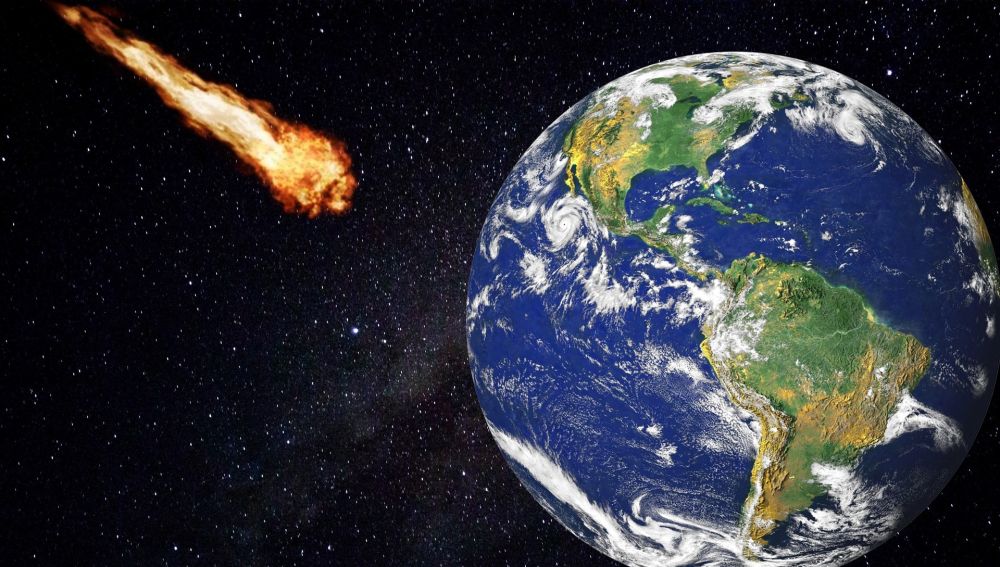
Un nuevo asteroide podría impactar contra la Tierra

Asteroide que se dirige a impactar contra la Tierra


La Agencia Espacial Europea (ESA) ha incorporado un asteroide recién descubierto a su lista de objetos con riesgo de impacto sobre la Tierra y lo ha clasificado como el cuarto más peligroso.

 EN RESUMEN
  • El meteorito mide 14 metros de diámetro
  • La ESA lo ha calificado como el cuarto más peligroso de su lista
  • El impacto tendría lugar el 16 de septiembre del año 2084
Desde hace años, la Agencia Espacial Europea (ESA) elabora una 'Lista de objetos con riesgo de impacto en la Tierra'. Tras los últimos descubrimientos, han incorporado un nuevo asteroide.
El meteorito fue descubierto el pasado 23 de septiembre y tiene unos 14 metros de diámetro. Los investigadores lo han clasificado como el cuarto más peligroso de la lista. Además de la 'Lista de riesgos', el SU3 2019, como ha sido identificado, también se encuentra en la 'Lista de Prioridades de la agencia', lo que significa que la ESA vigila de cerca su trayectoria.
Según los investigadores, las posibilidades del asteroide de golpear la Tierra son una entre 147 y, en el caso de que suceda, tendría lugar dentro de 65 años.
Se espera que el asteroide se vaya acercando desde una distancia de solo 0,00079 unidades astronómicas, aproximadamente a 118.000 kilómetros de distancia. Esta distancia es muy pequeña, por lo que un ligero empujón podría enviarlo a la tierra. De hacerlo, el potencial impacto tendría lugar el 16 de septiembre del año 2084.
Según la ESA, se trata de un asteroide Apollo con una órbita muy amplia alrededor de la Tierra y el Sol que, ocasionalmente, se cruza con la de la Tierra. Cuando el meteorito completa su órbita, a veces pasa cerca de otros planetas como Venus, Mercurio y Marte. La atracción de gravedad de cualquiera de estos planetas podría alterar fácilmente la trayectoria del asteroide.
El asteroide no es lo suficientemente grande como para causar un impacto importante en caso chocar contra la Tierra, ya que tiene un diámetro de 14 metros. Lo más probable es que estalle en la atmósfera.

jueves, 12 de septiembre de 2019

Agua en el planeta K2-18b: el “alucinante” hallazgo de una supertierra que podría alojar vida extraterrestre


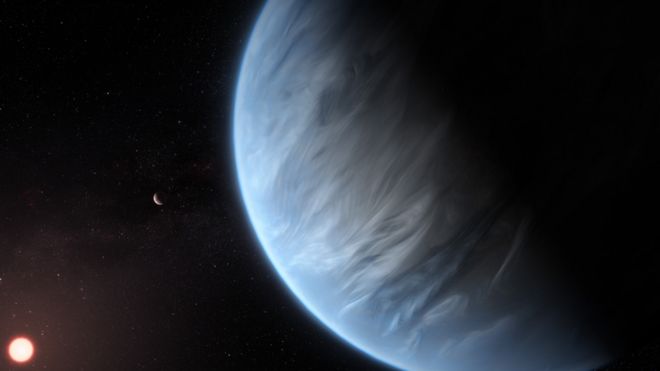
K2-18bDerechos de autor de la imagenESA/UCL
Image captionHasta un 50% de la atmósfera de K2-18b podría estar compuesta de agua.

El agua es una de las señales que los científicos buscan a la hora de saber si un planeta podría albergar vida o ser habitable.
Ahora, por primera vez, un equipo de astrónomos descubrió agua en la atmósfera de un planeta que orbita alrededor de una estrella distante.
Se llama K2-18b, es un exoplaneta (está fuera de nuestro sistema solar) y este hallazgo lo convierte en un candidato destacado en la búsqueda de vida extraterrestre.
"Esta es la primera vez que detectamos agua en un planeta ubicado en una zona habitable donde la temperatura es potencialmente compatible con la presencia de vida", dice Giovanna Tinetti, profesora del University College London (UCL), autora principal de la investigación.
La zona habitable es la región alrededor de una estrella donde las temperaturas son lo suficientemente favorables para que el agua exista en forma líquida en la superficie de un planeta.
Este logro es "alucinante", dijo Tinetti.

¿Qué sabemos de este planeta?

K2-18b está a 111 años luz, unos 1.000 billones de kilómetros desde la Tierra.
Eso es demasiado lejos para enviar una sonda, así que la única opción es esperar a que se lance la nueva generación de telescopios espaciales en la próxima década y buscar gases en la atmósfera del planeta que solo puedan ser producidos por organismos vivos.


TierraDerechos de autor de la imagenGETTY
Image captionLos investigadores buscan agua como señal de vida en otros planetas.

"Siempre nos hemos preguntado si estamos solos en el Universo", dice Ingo Waldmann, investigador del UCL. "Dentro de los próximos diez años, sabremos si hay químicos que se deben a la vida en esas atmósferas".
Para esta investigación, el equipo examinó la atmósfera de los planetas descubiertos por el telescopio espacial Hubble, entre 2016 y 2017.
Entre los planetas que observaron, el K2-18b fue el único que reveló la estructura molecular del agua.
Los modelos computacionales mostraron que hasta un 50% de su atmósfera podría ser agua.
El planeta tiene poco más del doble del tamaño de la Tierra y una temperatura lo suficientemente fría como para tener agua líquida, entre cero y 40 °C.
"Esto es increíblemente emocionante", dice Angelos Tsiaras, miembro del equipo del UCL.
"Esto nos acerca a responder la pregunta fundamental: ¿es la Tierra única?".


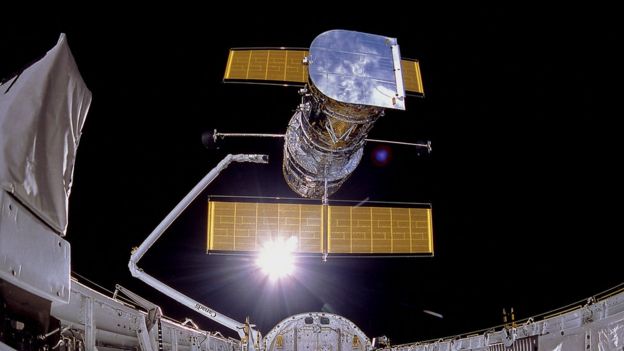
HubbleDerechos de autor de la imagenNASA
Image captionEl K2-18b fue uno de los exoplanetas detectados por el telescopio espacial Hubble.

Tarea complicada

Una dificultad para responder esta pregunta, sin embargo, es que los astrónomos aún no se ponen de acuerdo sobre qué gases constituirían evidencia de vida. Esa tarea no es nada fácil.
Para llegar a un consenso es probable que se requiera un estudio de la composición química de, quizás, cientos de planetas, además de una comprensión de cómo se crean y evolucionan, según explica Tinetti.
"La Tierra realmente se destaca en nuestro propio sistema solar. Tiene oxígeno, agua y ozono. Pero aun si encontramos todo eso alrededor de un planeta alrededor de una estrella distante, debemos tener cuidado al decir que es compatible con la vida", dice.
"Por eso necesitamos entender no solo un puñado de planetas en la galaxia, sino cientos de ellos. Y lo que esperamos es que los planetas habitables se destaquen, que veamos una gran diferencia entre los planetas que son habitables y los que no lo son".


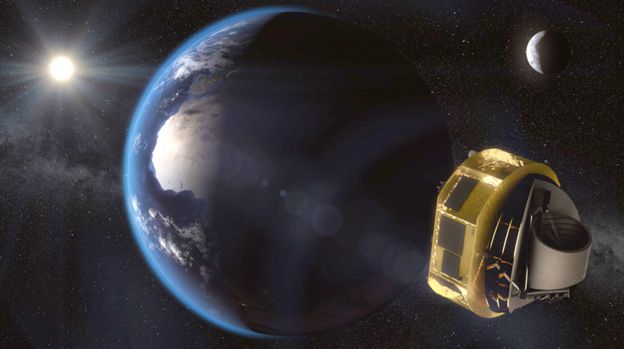
ArielDerechos de autor de la imagenESA/STFC RAL SPACE/UCL/EUROPLANET-SCIENCE OFFICE
Image captionLa misión Ariel podría ayudar a detectar vida en otros planetas.

Las supertierras

El posible lanzamiento del Telescopio Espacial James Webb de la NASA en 2021 y la misión Ariel de la Agencia Espacial Europea siete años después permitirán a los astrónomos estudiar en detalle las atmósferas de los diversos mundos que se han detectado hasta ahora.
Se ha encontrado agua en otros planetas, pero han sido demasiado grandes o demasiado calientes para permitir la vida. Los planetas más pequeños y fríos son mucho más difíciles de detectar.
K2-18b fue descubierto en 2015 y es uno de los cientos de "supertierras", como se le llaman a los planetas que tienen una masa que oscila entre la de la Tierra y la de Neptuno.
Estas supertierras fueron halladas por la nave espacial Kepler de la NASA y se espera que la misión Tess, también de la NASA, detecte otros cientos más en los próximos años.

lunes, 2 de septiembre de 2019

Veinte años después, se podrá conocer la verdad sobre la única detección de materia oscura


materia oscura
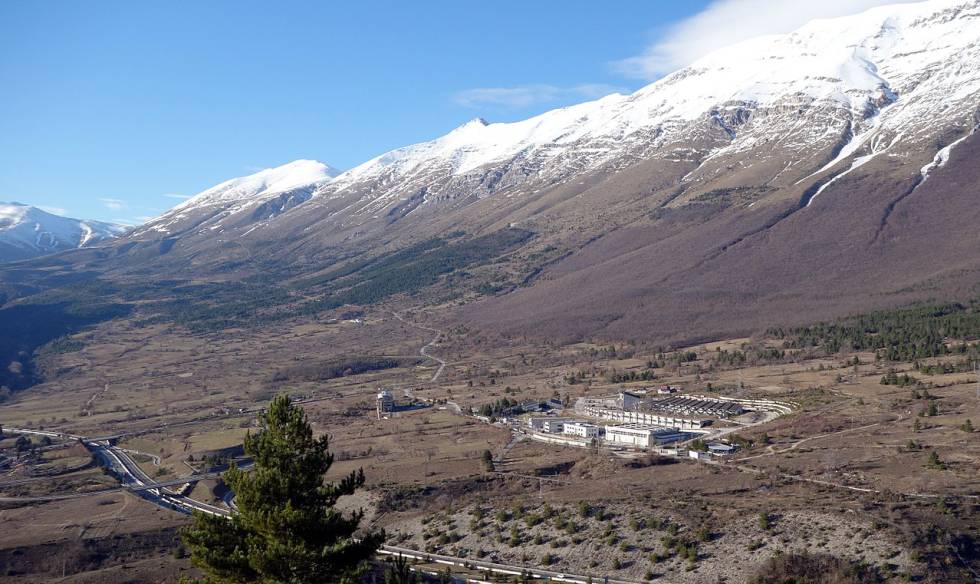
Vista de los edificios del Laboratorio Nacional del Gran Sasso. Debajo de ellos se encuentran varios experimentos, como DAMA INFN LNGS

Un experimento subterráneo en Italia lleva dos décadas detectando una fluctuación que sus responsables identifican con la materia oscura, pero que no ha logrado reconocimiento internacional


En la década de 1930, el astrónomo suizo Fritz Zwicky observó que algunos grupos de estrellas se movían más rápido de lo que debían. La masa visible no justificaba su velocidad y el científico planteó que debía existir una materia oscura que explicase su movimiento. Desde entonces, el concepto se ha convertido en una idea fundamental para explicar el cosmos, aunque sea como parte de una gigantesca incógnita. La materia visible, como la que componen los planetas o las estrellas, solo supone el 5% del universo. La materia oscura, de la que solo vemos sus efectos indirectos, es el 25%. El resto, la aún más misteriosa energía oscura.
Existen proyectos por todo el mundo que intentan producir o detectar la materia oscura, pero hasta ahora nadie ha tenido éxito. O nadie ha tenido un éxito reconocido por la comunidad científica. Desde hace más de veinte años, un equipo liderado por la profesora de la Universidad de Roma Rita Bernabei afirma que ha atrapado la materia oscura. Su supuesto logro se obtuvo gracias a DAMA, un detector de 100 kilos de yoduro de sodio instalado en un laboratorio enterrado a más de un kilómetro de profundidad, en el interior del Gran Sasso, en los Apeninos italianos. Ese detector era una sofisticada trampa para capturar algunas de las WIMPs (partículas masivas de interacción débil que, en teoría, conforman la materia oscura), que emitirían un destello luminoso al chocar contra alguno de los átomos del detector.

En 2021, los experimentos COSINE y ANAIS habrán acumulado datos suficientes para tener resultados fiables
La idea para observar un tipo de materia tan escurridizo la propuso en 1986 la investigadora de la Universidad de Texas (EE UU) Katherine Freese, que planteó que se podrían observar diferencias en la cantidad de materia oscura que atraviesa nuestro planeta en distintas épocas del año. Orbitamos alrededor del Sol que a su vez orbita dentro de nuestra galaxia acompañando al invisible halo de materia oscura. Como si se tratase de una nube de mosquitos que avanza, cuando siguiésemos su misma dirección a su misma velocidad, el número de impactos contra nuestro vehículo, sería menor, pero cuando al llegar al punto de nuestra órbita en el que cambiamos de dirección comenzásemos a avanzar contra la nube, se vería un incremento en el número de impactos. Ese pico de impactos es lo que observa alrededor del mes de junio el equipo de Gran Sasso desde 1997. Y las mismas observaciones han sido confirmadas por el mismo equipo y en el mismo lugar con un detector mejorado de 250 kilos de yoduro de sodio.
El problema para Bernabei y los suyos es que no es tan sencillo construir un detector con las características y la sensibilidad necesaria para que los resultados sean comparables. El choque de una partícula de materia oscura contra una de materia normal es algo tan extraño que no es sencillo aislarlo de cualquier otro fenómeno y hasta ahora, los esfuerzos para replicar el experimento no han podido ofrecer una respuesta concluyente.
Experimentos como CDMSII, instalado en la mina de Soudan, en Minnesota (EE UU), o Xenon 10, en el mismo laboratorio de Gran Sasso, no lograron encontrar la señal de materia oscura en el mismo rango energético que DAMA/LIBRA. Otro como CRESST, también en el laboratorio subterráneo italiano, obtuvo una señal, pero era demasiado débil y no parecía coincidir exactamente con la del equipo de Bernabei. En 2017, una versión mejorada de Xenon 10, Xenon 100, no encontró señal alguna de materia oscura buscando donde DAMA encuentra su señal, pero una vez más, se planteó la posibilidad de que al emplear xenon como material para atrapar las partículas en lugar de yoduro de sodio los resultados podían no ser comparables.
Según recordaba recientemente la revista de física de partículas Symmetry, después de dos décadas de controversia, el fin a la incertidumbre puede estar cerca. Ya hay varios experimentos en marcha diseñados para tener resultados comparables sin dudas. Uno de ellos, ANAIS, liderado por la Universidad de Zaragoza e instalado en el Laboratorio Subterráneo de Canfranc (España), también utiliza yoduro de sodio. Comenzó a recoger datos en 2017 y en los próximos años habrá acumulado una cantidad suficiente para que sea estadísticamente significativa.
Si los resultados son positivos, se podría empezar a saber qué compone el 25% de todo el universo, hasta ahora desconocido
Otro de ellos es COSINE 100, un detector que también utiliza cristales de yoduro de sodio que a su vez están sumergidos en 2000 litros de líquido para reducir el ruido de fondo que provocan otro tipo de partículas y dificultan ver las débiles interacciones de la materia oscura. Este proyecto, instalado en Corea del Sur, comenzó a tomar datos en 2016 y en diciembre de 2018 publicó sus primeros resultados en la revista Nature. Según el artículo, era muy improbable que los resultados de DAMA/LIBRA coincidiesen con las características que el Modelo Estándar, la teoría que explica el comportamiento de la materia a nivel subatómico, atribuye a la materia oscura que ocupa el halo galáctico. No obstante, el experimento necesita acumular datos durante al menos dos años más para tener datos suficientes que digan si esas variaciones en las señales que captan los detectores de DAMA en las distintas épocas del año existen o si se pueden atribuir a la materia oscura.
Reina Maruyama, una investigadora de la Universidad de Yale que ha recibido financiación de la National Science Foundation para poner a prueba los resultados de DAMA con COSINE aseguraba a Symmetry que “con cinco años de funcionamiento del experimento, si la señal está ahí, en 2021, deberíamos ser capaces de verla”. “Si no está ahí, aunque esto es más difícil de hacer, también seremos capaces de refutarla”, añade.
Si tanto ANAIS como COSINE confirman los resultados de DAMA, el siguiente paso sería volver a buscar la misma fluctuación desde un detector en el hemisferio sur. Con ese objetivo está previsto que este mismo otoño comience en una antigua mina de oro en Australia la construcción del experimento SABRE. Después, se trataría de comenzar a analizar la señal para conocer detalles como la masa y empezar a describir la naturaleza de esos WIMPs que componen la materia oscura. En caso de que el resultado fuese negativo, habría que seguir buscando por otro lado, aunque aún quedaría por resolver de dónde viene esa fluctuación misteriosa que, desde hace 20 años, Rita Bernabei y los suyos dicen que es la primera detección de materia oscura.

domingo, 18 de agosto de 2019

Detectan por primera vez un agujero negro tragando a una estrella de neutrones

Los científicos creen haber detectado un nuevo tipo de evento cósmico: el triste final de una estrella de neutrones.

Detectan por primera vez un agujero negro tragando a una estrella de neutrones
Imagen ilustrativa
NASA / M. Helfenbein, Yale University / OPAC

Las fuertes ondas gravitacionales registradas en el cosmos por el Observatorio de Ondas Gravitacionales con Interferómetro Láser (LIGO) o el interferómetro Virgo han revelado lo que los expertos creen que puede ser la primera detección de una estrella de neutrones tragada por un agujero negro.
El evento histórico, que se detectó el 14 de agosto y recibió el nombre de S190814bv, fue registrado el miércoles en una base de datos pública utilizada por los astrónomos. El análisisinicial sugiere que hay un 99 por ciento de posibilidades de que las ondas sean las secuelas de la fusión cataclísmica de una estrella de neutrones con un agujero negro.
"Hasta ahora, obviamente no se parece a nada que hayamos detectado con mucha seguridad antes", dijo a Science News Daniel Holz, científico de la Universidad de Chicago y miembro de LIGO. Cree que la detección potencial ya es emocionante por sí sola. "Lo primero de cualquier cosa es siempre realmente fascinante", añadió.
Los científicos aún están analizando los datos para verificar qué fue lo que generó las ondas gravitacionales. Si se confirman las suposiciones, esta sería la primera detección sólida de un tipo de fenómeno nunca antes visto. Los investigadores estiman que el choque entre los dos objetos ocurrió a unos 900 millones de años luz de distancia

sábado, 3 de agosto de 2019

All Life on Earth is Made up of the Same 20 Amino Acids. Scientist Now Think They Know Why


The question of how life on Earth first emerged is one that humans have been asking themselves since time immemorial. While scientists are relatively confident about when it happened, there has been no definitive answer as to why it did. How did amino acids, the chemical building blocks of life, come together roughly four billion years ago to create the first protein molecules?
While that question is still unanswered, scientists are making new discoveries that could help narrow it down. For instance, a team of researchers from the Georgia Institute of Technology’s Center for Chemical Evolution (CCT) recently conducted a study that showed how some of the earliest predecessors of the protein molecule may have spontaneously linked up to form a chain.

The study recently appeared in the Proceedings of the National Academy of Sciences. The study was led by Dr. Moran Frenkel-Pinter of Georgia Tech and included multiple researchers from the CCT – which is supported by NASA and the National Science Foundation (NSF) – with assistance from Dr. Luke Leman, and assistant professor of chemistry at Scripps Research, a non-profit medical research institute.
Earth's Hadean Eon is a bit of a mystery to us, because geologic evidence from that time is scarce. Researchers at the Australian National University have used tiny zircon grains to get a better picture of early Earth. Credit: NASA

Earth’s Hadean Eon is a bit of a mystery to us, because geologic evidence from that time is scarce. Researchers at the Australian National University have used tiny zircon grains to get a better picture of early Earth. Credit: NASA

For decades, scientists have had theories about how the first amino acids came together to form protein molecules. Unfortunately, all attempts to verify these theories have so far failed. As Dr. Leman explained:
“How chemistry led to complex life is one of the most fascinating questions that mankind has pondered. There are a lot of theories about the origins of proteins but not so much experimental laboratory support for these ideas.”
For their study, the research team conducted an experiment where a small selection of amino acids (lysine, arginine, and histidine) were placed together with three non-biological competitor amino acids. The acids were then subjected to conditions similar to what is believed to have existed on Earth during the Hadean Eon (ca. 4 billion years ago).
This consisted of putting the selected amino acids in water containing hydroxy acids, which are known to facilitate amino acid reactions and would have been common on prebiotic Earth. The mixture was then heated to 85 °C (185 °F), which sped up the reaction process and caused the water to evaporate. The resulting chemical reactions were then studied.

The building blocks of life may have formed on primordial Earth spontaneously. Credit: ocean.si.edu

To their surprise, the biological amino acids spontaneously formed into neat segments that linked together via ?-amine groups. These groups are those that are made of nitrogen and hydrogen and are quite reactive. However, they are also part of the core of amino acids and other amines that form sidechains that extend from the core (which were used in this experiment) are often more reactive. As Dr. Frenkel-Pinter said:
“It surprised us that this chemistry favored the ?-amine connection found in proteins, even though chemical principles might have led us to believe that the non-protein connection would be favored. The preference for the protein-like linkage over non-protein was about seven to one.”
Another surprise was the fact that the biological amino acids beat out the non-biological ones in terms of reactivity. The latter acids, which are not found in proteins today, had the potential to chemically react just as well (or better than) the biological ones. What’s more, the team anticipated that the inclusion of these acids would give the biological ones a run for their money and might even lead to the creation of new proteins.
However, the reactions resulted mostly in the formation of peptides (two or more amino acid building blocks linked together) that were closer to today’s actual proteins. In particular, the researchers thought that the non-biological amino acids would outcompete the biological amino acid known as lysine and that lysine would not be able to form chains reliably.

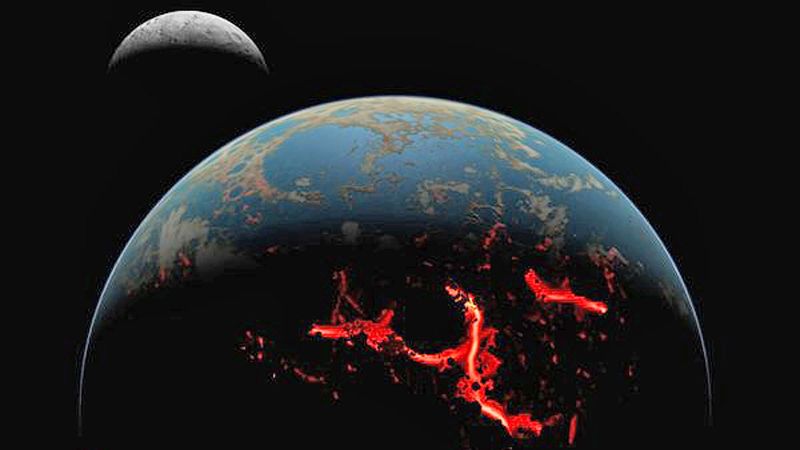
An artist’s rendering of the early moon and Earth, which sustained many asteroid impacts. Credit: Simone Marchi (SwRI)/SSERVI/NASA

In both cases, they were wrong and instead found that the lysine predominantly went into the chains in a way that it is similar to what happens with proteins today. From this, the team hypothesized that prefabricated amino acid chains that are useful in living systems evolved before life had found a way to make proteins.
The fact that their experiment showed that biological amino acids are preferred over non-biological ones may also offer new insight into why just 20 amino acids went into the formation of life. Scientists believe that there were over 500 naturally-occurring acids present on Earth during the Hadean Eon. As Loren Williams, a professor of biochemistry at Georgia Tech, explained:
“Our idea is that life started with the many building blocks that were there and selected a subset of them, but we don’t know how much was selected on the basis of pure chemistry or how much biological processes did the selecting. Looking at this study, it appears today’s biology may reflect these early prebiotic chemical reactions more than we had thought.”
“In the prebiotic Earth, there would have been a much larger set of amino acids. Is there something special about these 20 amino acids, or did these just get frozen at a moment in time by evolution?” In short, the experiment suggests that the kinds of amino acids used in proteins are more likely to link up together because they react together more efficiently and have few inefficient side reactions.
Artist's depiction of a waterworld. A new study suggests that Earth is in a minority when it comes to planets, and that most habitable planets may be greater than 90% ocean. Credit: David A. Aguilar (CfA)

The first amino acids likely formed in water with hydroxy acids, which were then subjected to dry conditions. Credit: David A. Aguilar (CfA)

In short, the experiment suggests that the kinds of amino acids used in proteins are more likely to link up together because they react together more efficiently and have few inefficient side reactions. It also lends additional credibility to the theory that most biological polymers formed in wet and dry cycles, which is something that CCT researchers have been arguing for years.
This theory, which states that the first proteins occurred on rain-swept dirt flats or sun-baked lakeshore rocks, is at odds with the more conventional narrative that the building blocks of life rely on rare and cataclysmic events, as well as multiple ingredients in order to emerge. By showing that it was likely to be a much more straightforward process, this research could bring us one step closer to unlocking this age-old mystery.
It could also have implications in the search for life beyond Earth. If the building blocks of life are naturally reactive and attracted to one another, then it likely increases the odds that similar chemical reactions took place elsewhere in the Universe!


Captada una señal de ondas gravitacionales nunca vista

  Los detectores LIGO y Virgo captan dos choques de agujeros negros contra estrellas de neutrones, los astros más densos del universo. Dos d...