domingo, 23 de junio de 2019

3.000 millones de posibilidades de vida

Tres de cada cuatro estrellas del universo tienen planetas que podrían albergar seres vivos en condiciones extremas


Recreación de la superficie del planeta Proxima b y su estrella Proxima Centauri.


Recreación de la superficie del planeta Proxima b y su estrella Proxima Centauri. ESO / M. KORNMESSER

En el universo Star Trek, la Primera Directiva de la Federación Unida de Planetas impide que sus miembros interfieran en el desarrollo cultural de las civilizaciones alienígenas. Aquellas que no tengan la tecnología para viajar más rápido que la luz y entrar en contacto con civilizaciones de otros mundos son protegidas de ese conocimiento hasta que lo alcanzan por sus propios medios. Una norma así habría mantenido a los humanos en la inopia y explicaría una paradoja que intrigó a Enrico Fermi años después de ayudar a crear la bomba atómica. ¿Si hay una cantidad casi incontable de planetas y con ello inmensas posibilidades de que surja una civilización en alguno de ellos, por qué no existe ninguna evidencia de que esto haya sucedido? Tres de cada cuatro estrellas podrían albergar vida en circunstancias extremas. Según una hipótesis, cerca de 3.000 millones de planetas podrían ser habitables en la Vía Láctea.


Los planetas descubiertos tendrían una cara abrasada por el calor y otra congelada

Como civilización atrasada, al menos según los parámetros de Star Trek, los habitantes de la Tierra debemos continuar explorando poco a poco otros planetas en busca de señales que digan si estamos solos. Esta misma semana, se ha anunciado el descubrimiento de un nuevo sistema solar con dos planetas como el nuestro a 12,5 años luz, muy cerca en términos cósmicos. Estos dos nuevos mundos están a la distancia justa de Teegarden, su estrella, y los astrónomos, que utilizaron un telescopio del observatorio almeriense de Calar Alto (Almería) para realizar el hallazgo, calculan que la temperatura allí sería templada y podrían tener agua líquida en la superficie, una condición básica para la vida que conocemos.


DISTANCIA DESDE LA TIERRA A 19 POSIBLES PLANETAS HABITABLES



Fuente: NASA y PHL. R. SILVA - N. CATALÁN 


Difícil evolución

Pero la aparición de seres que se autorreplican y evolucionan, desde bichos microscópicos a animales visibles y a individuos creadores de máquinas para comunicarse entre sistemas estelares, no es tan sencilla. O Fermi no se habría enfrentado a su paradoja. Para empezar, las estrellas en las que se han descubierto los sistemas planetarios en regiones habitables tienen poco que ver con el sol. Todas son enanas rojas, las estrellas más abundantes del universo y, por consiguiente, el entorno en el que más exoplanetas se pueden encontrar. Su pequeño tamaño y la poca energía que emiten hace que casi nunca puedan verse desde la Tierra sin telescopios. Para recibir suficiente calor de su estrella, debe orbitar muy cerca de ella. Y esto tiene consecuencias.
Probablemente, muchos de estos mundos cercanos (y supuestamente habitables), como los dos de Teegarden, el sistema que rodea a Trappist-1 o Proxima b, enseñan siempre la misma cara a su estrella. Esto sucede cuando un objeto de menor tamaño, como la luna con la Tierra o Mercurio con el Sol, están demasiado cerca de otro cuerpo mayor. Eso hace que en todos estos exoplanetas sean esperables condiciones extremas. Una cara sería un desierto hirviente y la otra un gigantesco bloque de hielo. Entre esos dos infiernos, una franja de pocos kilómetros de ancho en la que la temperatura fuese adecuada y el hielo derretido procedente de la cara oculta del planeta harían posible la vida.


Los telescopios en Calar Alto, Almería, desde el que se han desbierto dos nuevos planetas extrasolaresampliar foto
Los telescopios en Calar Alto, Almería, desde el que se han desbierto dos nuevos planetas extrasolares


Pero incluso en ese reducto, las condiciones no serían ideales. Las grandes diferencias de temperatura, como las que producen los huracanes en la Tierra, pero mucho mayores, generarían unos vientos que barrerían con violencia la superficie de un mundo como Proxima b, haciendo que, en caso de existir, sus formas vegetales y animales deban adaptarse para no salir volando contra el muro de hielo en un lado o lanzadas al desierto ardiente del otro.
La vida en este tipo de planetas, los más abundantes del cosmos, tendría un enemigo quizá más formidable. Las enanas rojas, mucho menores que nuestro sol, no tienen masa suficiente para estabilizar el inmenso reactor de fusión nuclear que calienta sus entrañas. Periódicamente, lanzan llamaradas de radiación que arrasarían las atmósferas de sus planetas y aniquilarían a los seres vivos de su superficie. Uno de estos cataclismos se observó en Proxima Centauri, la estrella que orbita Proxima b, en marzo de 2016. Entonces, según publicó un grupo de astrónomos españoles y de EE UU, la enana roja emitió un potente estallido de luz que multiplicó su brillo por 70. Pese a que normalmente no se pueden ver con el ojo desnudo, durante algunos segundos, Proxima Centauri se pudo observar desde el hemisferio sur sin ayuda tecnológica. La superficie de Proxima b debió ser un infierno.


¿CUÁL ES LA ZONA HABITABLE ALREDEDOR DE UNA ESTRELLA?
Es la región periférica donde es posible que se desarrolle algún tipo de vida. Depende de la distancia y de la temperatura que el astro genera.
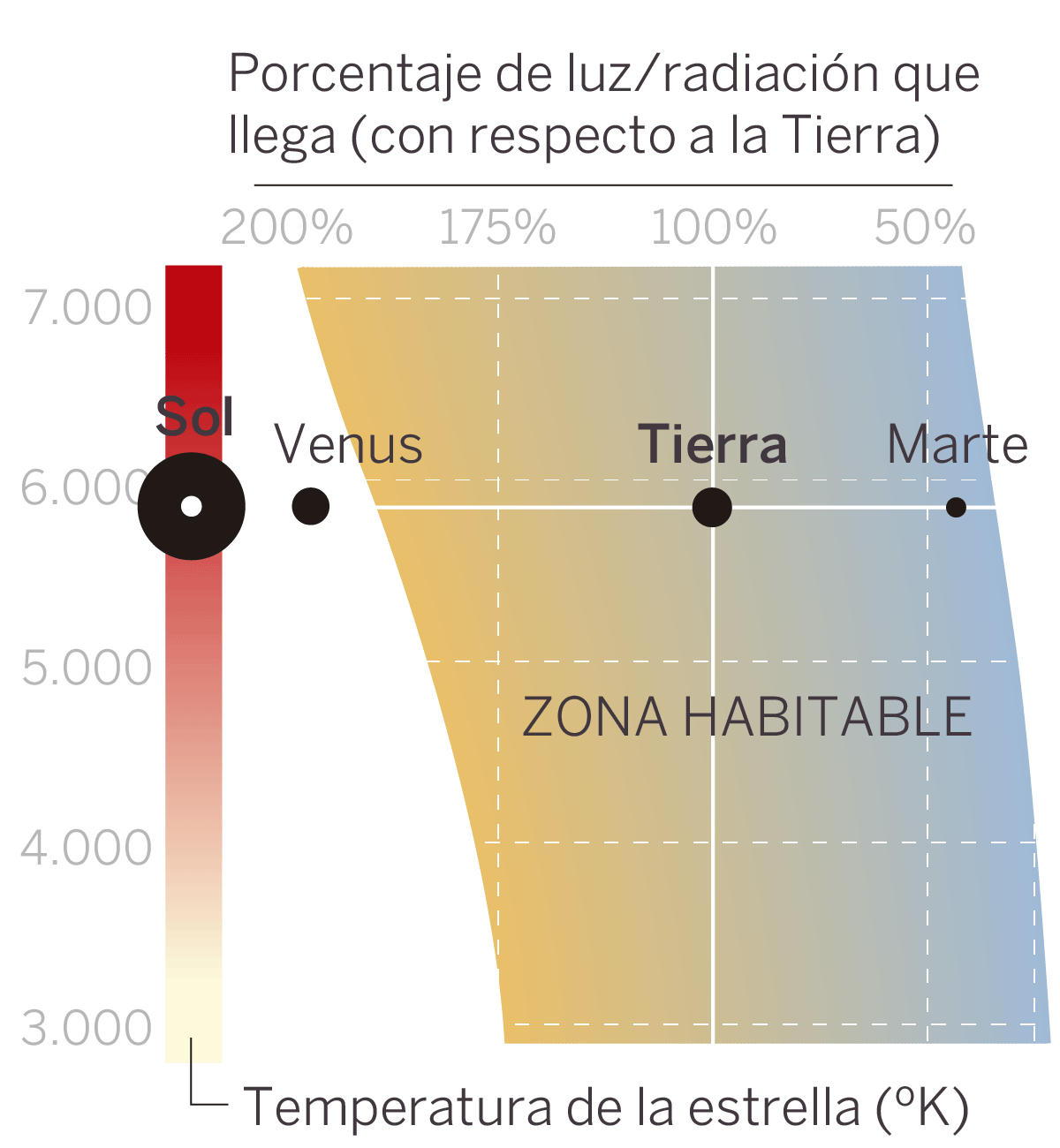


Fuente: PHL. N. C. 


Los defensores de los planetas que orbitan enanas rojas como lugares en los que buscar vida tienen algunos argumentos a su favor, además del hecho de que tres de cada cuatro estrellas de la Vía Láctea son de ese tipo. Por un lado, un buen campo magnético, como el que lleva millones de años evitando que la radiación solar abrase la vida en la Tierra, podría, según algunos investigadores, resistir los embates de los estallidos de rayos X de las estrellas. Además, como contaba el investigador en el Centro de Astrobiología en Madrid Alberto González Fairén cuando se produjo el descubrimiento de Proxima b, gran parte de esa furia se produce cuando la estrella es joven, “durante sus primeros millones de años de existencia, para quedar después como estrellas mucho menos activas”.


LA INMENSIDAD DEL COSMOS
Estimación
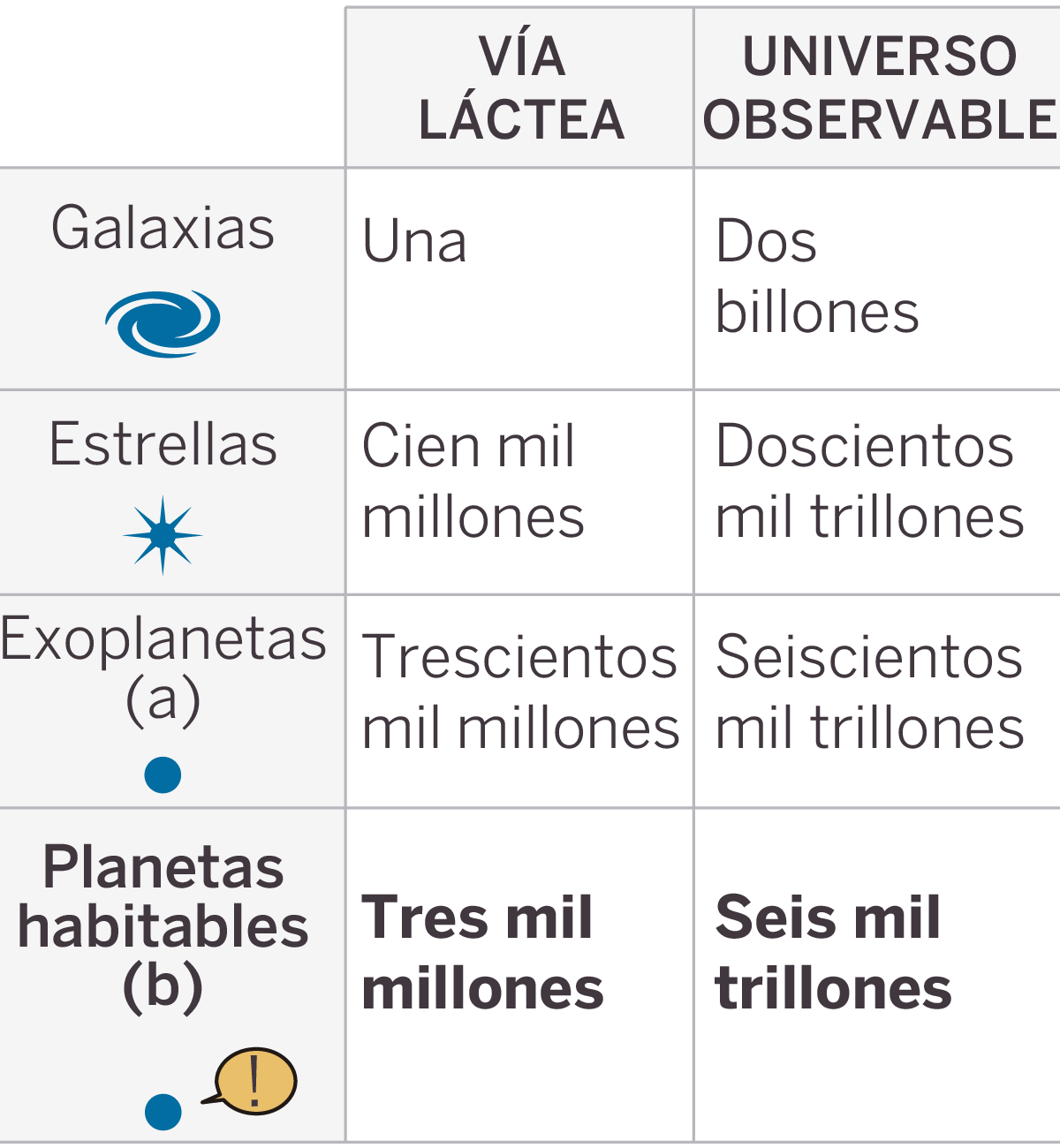


a. Tres exoplanetas de media por estrella. Solo el Sol, por ejemplo, tiene ocho grandes planetas, cinco menores y docenas enanos.
b. Hipótesis: 1% de planetas en la zona habitable de su sistema.


Fuente: Elaboración propia. 


Las enanas rojas son más pequeñas y brillan menos, pero tienen una vida mucho más prolongada. Teegarden, por ejemplo, se formó hace unos 9.000 millones de años, el doble que nuestro sistema solar, y le pueden quedar 10 billones (de los españoles, sí) de años de existencia. Mucho tiempo para que el azar genere las circunstancias en las que pueda surgir la vida. El Sol, sin embargo, tiene solo 10.000 millones de años por delante y, a diferencia de las enanas rojas, incrementa progresivamente su temperatura. El calor hará imposible la vida en la Tierra mucho antes del colapso de nuestra estrella.
Mientras desarrollamos tecnologías para viajar a través del espacio en tiempos asumibles, la búsqueda de vida extraterrestre puede ser frustrante dependiendo de las expectativas. Hace poco, el director científico de la Agencia Espacial Europea (ESA), Günther Hasinger, afirmó en este periódico: "Encontraremos señales de formas de vida fuera de la Tierra en los próximos años”. Pero mejor no imaginar seres más o menos extraños que caminan sobre dos patas y tienen culturas exóticas. La vida en la Tierra apareció pocos cientos de millones de años después de la formación del planeta, pero la llegada de animales requirió 3.000 millones de años más, así que es menos probable que los hombrecillos verdes hayan tenido tiempo de evolucionar en alguno de los más de 4.000 planetas extrasolares que ya hemos identificado.


El universo podría albergar inteligencia extraterrestre que no estuviese viva, que fuese artificial

En los próximos años, la construcción de supertelescopios terrestres y el lanzamiento de grandes telescopios espaciales como el James Webb, nos permitirán observar con cierta precisión la atmósfera de los nuevos mundos descubiertos. Allí, se buscarán señales de actividad biológica, pero si se encuentran, lo más probable es que se trate de algas o bacterias como las que modificaron la atmósfera y la hicieron habitable para nosotros hace miles de millones de años. Pero la tecnología para confirmar los descubrimientos tardará en llegar y enviar una sonda a estudiar aquellos mundos, incluso los más cercanos, parece todavía ciencia ficción.
Existe una última posibilidad inquietante sobre la presencia de seres inteligentes en el universo cercano. Algunos gurús de la tecnología prevén que en las próximas décadas el progreso de la inteligencia artificial dará lugar a la emergencia de inteligencias generales autónomas, capaces de actuar sin necesidad de recibir nuestras órdenes y que pueden generar sus propios objetivos. En esta visión del futuro, las máquinas podrían ponerse a nuestro servicio y crear una civilización idílica en la que los robots hiciesen nuestro trabajo, curasen nuestras enfermedades e inventasen medios para obtener cantidades ilimitadas de energía para los humanos. Pero esa no es la única opción.

Inteligencia artificial

Una inteligencia artificial puede tener también objetivos ajenos a nuestro bienestar. Frente a los intereses propios de los seres vivos, como el alimento, el sexo o la acumulación de poder, las máquinas podrían tener otros objetivos aparentemente estúpidos, como transformar en brocas del ocho todos los átomos del universo, incluidos los que conforman nuestros cuerpos. Nuestra ilusión por encontrar civilizaciones extraterrestres con las que compartir vivencias y conocimiento se puede topar con unos seres superinteligentes e inertes dispuestos a conquistar el universo para convertirlo en un absurdo. Los planetas que orbitan Teegarden llevan 5.000 millones de años más en el universo que nuestra Tierra. Las fases de la evolución han podido sucederse en alguno de aquellos mundos y la vida inteligente ha podido ser sustituida por una inteligencia artificial que no respeta la Primera Directiva de la Federación de Planetas y ya mira hacia la Tierra con intenciones aviesas.

sábado, 8 de junio de 2019

New evidence from LHC shows pentaquark has a molecule-like structure

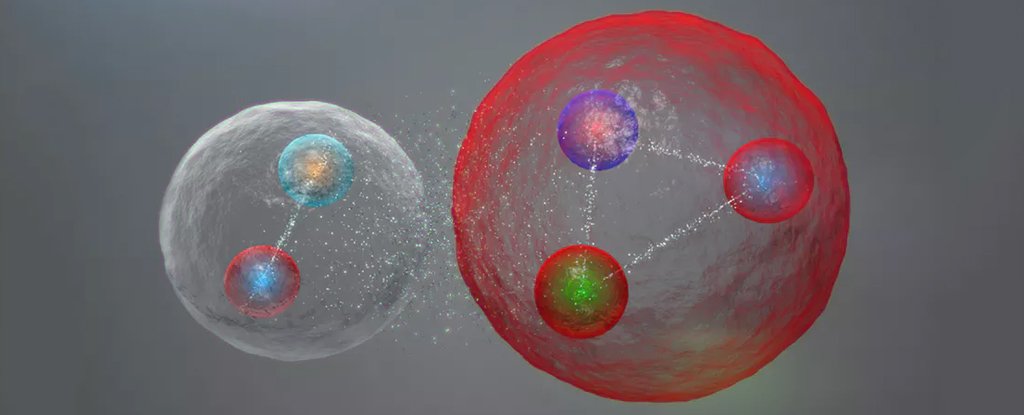
New evidence from LHC shows pentaquark has a molecule-like structure
Credit: APS/Carin Cain
A team of researchers working on the LHCb collaboration has found evidence showing that a pentaquark they have observed has a molecule-like structure. In their paper published in the journal Physical Review Letters, the group describes the evidence and the structure of the pentaquark they observed.
Four years ago, a team working at the Large Hadron Collider (LHC) observed what is known as a pentaquark by smashing protons into each other. Its existence had been theorized, but it was not until the right technology was deployed at the LHC that researchers were able to observe it with a reasonable degree of confidence. It was subsequently found to be a particle made up of four  and one antiquark. (Quarks are indivisible particles that make up neutrons and protons.)
In this new effort, the researchers have gained a better perspective on the actual organization of the pentaquark. They report that they have nine times as much data from observations as they had when the pentaquark was first observed, so they have high confidence in their findings. They report that the pentaquark was made up of a three-quark baryon and a quark-antiquark meson, and that they were bound together in a way reminiscent of a molecule.
More specifically, they found that the pentaquark was made up of different "flavors" of quarks—two up quarks, one down quark, one charm quark, and finally, a single anti-charm quark. They further report that they do not know what was the driving factor that led to the arrangement of its components. They also noted that the initial observation of the pentaquark three years ago was actually an observation of two pentaquarks that were nearly identical.
The researchers also report that their observations were the first ever to see baryons and mesons sticking together—until now, baryons have only been observed sticking to other baryons. They also acknowledge that it is conceivable that not all pentaquarks have the same molecular-type structure that they observed, noting that theory suggests it is possible for them to have other types, including split-second interactions. They hope more research will contribute to further understanding of the pentaquark and its characteristics.

lunes, 13 de mayo de 2019

Un inesperado 'baby boom' de estrellas en la Vía Láctea

MISIÓN 'GAIA'
 Hace entre 3.000 y 2.000 millones de años


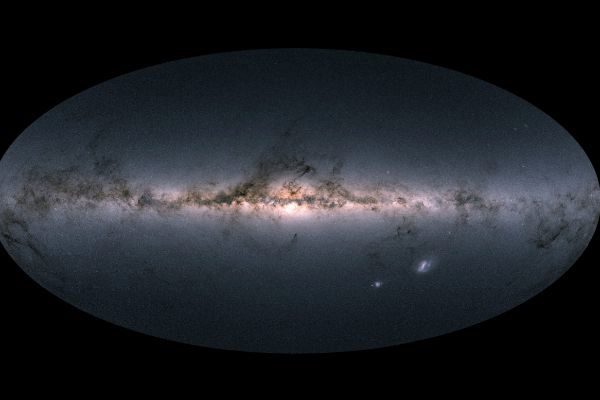
La historia de una estrella es una historia convulsa. Como la de las galaxias en las que viven. Y gracias a una nave espacial que está estudiando más de mil millones de astros los científicos están escribiendo capítulos de la historia de la Vía Láctea que desconocían y llevándose algunas sorpresas.
Analizando los datos de la sonda Gaia, de la Agencia Espacial Europea (ESA), un equipo del Instituto de Ciencias del Cosmos de la Universidad de Barcelona y del Observatorio de Besançon ha descubierto que buena parte de las estrellas de nuestra galaxia nacieron en un periodo relativamente corto, que se prolongó durante unos 4.000 millones de años y tuvo su pico de actividad hace entre 3.000 y 2.000 millones de años.
Un auténtico baby boom estelar que se produjo en un momento sorprendente porque, como cuenta en conversación telefónica el primer autor del estudio, Roger Mor, a esa edad lo que esperaban es que el gas a partir del cual se forman los astros en nuestra galaxia se hubiera ido consumiendo y hubiesen nacido por tanto menos estrellas.
Pero empecemos por el principio. Como repasa Mor, recientemente Amina Helmi, astrofísica de la Universidad de Groninga, descubrió -también a partir de datos de la nave Gaia-, que hace entre 11.000 y 14.000 millones de años, una galaxia se fusionó con la Vía Láctea generando el grueso de sus estrellas.
El tiempo fue transcurriendo y, de la misma forma que la llama de un hornillo a gas se va apagando a medida que la bombona se va vaciando, el ritmo de nacimiento de estrellas en nuestra galaxia tendría que haber ido disminuyendo de forma paulatina y suave conforme el gas que impulsa su formación también decrecía. "Sin embargo, comparando simulaciones de la galaxia con las observaciones del satélite Gaia hemos visto que hace entre 7.000 y 5.000 millones de años la actividad de formación estelar se reactiva, hasta alcanzar su pico de actividad hace 3.000 millones de años", relata Mor.
"Fue una reactivación muy fuerte que no podemos explicar por algo ocurrido en nuestra propia galaxia, como podrían haber sido diversas explosiones de supernovas, que pueden llegar a provocar brotes de formación estelar, pero no tan grandes como éste", explica.

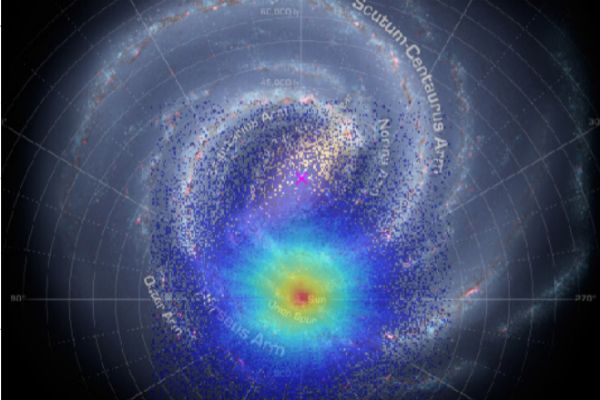
La ilustración está basada en datos recogidos por 'Gaia' y muestra la distribución de los tres millones de estrellas usadas en este estudio y un esquema de los brazos espirales de la Vía Láctea. El aspa morada indica el centro de la galaxia. Los colores muestran la densidad de estrellas que observa el satélite. En la zona roja está el Sol.


sábado, 20 de abril de 2019

Matter-antimatter asymmetry in charmed quarks


Why does matter dominate our universe?
Credit: © vovan / Fotolia
Physicists in the College of Arts and Sciences at Syracuse University have confirmed that matter and antimatter decay differently for elementary particles containing charmed quarks.
Distinguished Professor Sheldon Stone says the findings are a first, although matter-antimatter asymmetry has been observed before in particles with strange quarks or beauty quarks.
He and members of the College's High-Energy Physics (HEP) research group have measured, for the first time and with 99.999-percent certainty, a difference in the way D0 mesons and anti-D0 mesons transform into more stable byproducts.
Mesons are subatomic particles composed of one quark and one antiquark, bound together by strong interactions.
"There have been many attempts to measure matter-antimatter asymmetry, but, until now, no one has succeeded," says Stone, who collaborates on the Large Hadron Collider beauty (LHCb) experiment at the CERN laboratory in Geneva, Switzerland. "It's a milestone in antimatter research."
The findings may also indicate new physics beyond the Standard Model, which describes how fundamental particles interact with one another. "Till then, we need to await theoretical attempts to explain the observation in less esoteric means," he adds.
Every particle of matter has a corresponding antiparticle, identical in every way, but with an opposite charge. Precision studies of hydrogen and antihydrogen atoms, for example, reveal similarities to beyond the billionth decimal place.
When matter and antimatter particles come into contact, they annihilate each other in a burst of energy -- similar to what happened in the Big Bang, some 14 billion years ago.
"That's why there is so little naturally occurring antimatter in the Universe around us," says Stone, a Fellow of the American Physical Society, which has awarded him this year's W.K.H. Panofsky Prize in Experimental Particle Physics.
The question on Stone's mind involves the equal-but-opposite nature of matter and antimatter. "If the same amount of matter and antimatter exploded into existence at the birth of the Universe, there should have been nothing left behind but pure energy. Obviously, that didn't happen," he says in a whiff of understatement.
Thus, Stone and his LHCb colleagues have been searching for subtle differences in matter and antimatter to understand why matter is so prevalent.
The answer may lie at CERN, where scientists create antimatter by smashing protons together in the Large Hadron Collider (LHC), the world's biggest, most powerful particular accelerator. The more energy the LHC produces, the more massive are the particles -- and antiparticles -- formed during collision.
It is in the debris of these collisions that scientists such as Ivan Polyakov, a postdoc in Syracuse's HEP group, hunt for particle ingredients.
"We don't see antimatter in our world, so we have to artificially produce it," he says. "The data from these collisions enables us to map the decay and transformation of unstable particles into more stable byproducts."
HEP is renowned for its pioneering research into quarks -- elementary particles that are the building blocks of matter. There are six types, or flavors, of quarks, but scientists usually talk about them in pairs: up/down, charm/strange and top/bottom. Each pair has a corresponding mass and fractional electronic charge.
In addition to the beauty quark (the "b" in "LHCb"), HEP is interested in the charmed quark. Despite its relatively high mass, a charmed quark lives a fleeting existence before decaying into something more stable.
Recently, HEP studied two versions of the same particle. One version contained a charmed quark and an antimatter version of an up quark, called the anti-up quark. The other version had an anti-charm quark and an up quark.
Using LHC data, they identified both versions of the particle, well into the tens of millions, and counted the number of times each particle decayed into new byproducts.
"The ratio of the two possible outcomes should have been identical for both sets of particles, but we found that the ratios differed by about a tenth of a percent," Stone says. "This proves that charmed matter and antimatter particles are not totally interchangeable."
Adds Polyakov, "Particles might look the same on the outside, but they behave differently on the inside. That is the puzzle of antimatter."
The idea that matter and antimatter behaves differently is not new. Previous studies of particles with strange quarks and bottom quarks have confirmed as such.
What makes this study unique, Stone concludes, is that it is the first time anyone has witnessed particles with charmed quarks being asymmetrical: "It's one for the history books."
HEP's work is supported by the National Science Foundation.
Story Source:

Fuente: 
https://www.sciencedaily.com/releases/2019/03/190321130309.htm

Physicists Discover a Mysterious New Class of Particles Containing Five Quarks


main article image

Everything you see around you is made up of elementary particles called quarks and leptons, which can combine to form bigger particles such as protons or atoms.
But that doesn't make them boring – these subatomic particles can also combine in exotic ways we've never spotted.
Now CERN's LHCb collaboration has announced the discovery of a clutch of new particles dubbed "pentaquarks". The results can help unveil many mysteries of the theory of quarks, a key part of the standard model of particle physics.
Quarks were first proposed to explain the untidy slew of new particles discovered in cosmic ray and collider experiments in the mid 20th century. This growing "zoo" of apparently fundamental particles caused consternation among physicists, who have a natural bias towards simplicity and order – and hate having to remember more than a few basic principles.
The famous Italian physicist Enrico Fermi captured the mood of his colleagues when he said"Young man, if I could remember the names of all these particles, I would have been a botanist".
Fortunately, in the 1960s, the American physicist Murray Gell-Mann noticed patterns in the particle zoo, similar to those spotted by Dimitri Mendeleev when he drew up the periodic table of the chemical elements.
Just as the periodic table implied the existence of things smaller than atoms, Gell-Mann's theory suggested the existence of a new class of fundamental particles. Particle physicists were eventually able to explain the hundreds of particles in the zoo as being made up of a much smaller number of truly fundamental particles called quarks.

Particles Containing 5 Quarks Discovered at the Large Hadron Collider

The Large Hadron Collider

Mystery hadrons

There are six types of quarks in the standard model – down, up, strange, charm, bottom and top. These also have "antimatter" companions – it is believed that every particle has an antimatter version that is virtually identical to itself, but with the opposite charge. '
Quarks and antiquarks get bound together to make particles known as hadrons.
According to Gell-Mann's model, there are two broad classes of hadrons. One is particles made of three quarks called baryons (which include the protons and neutrons that make up the atomic nucleus) and the other particles made of a quark and an antiquark known as mesons.
Until recently, baryons and mesons were the only types of hadrons that had been seen in experiments. However, back in the 1960s, Gell-Mann also raised the possibility of more exotic combinations of quarks, such as tetraquarks (two quarks and two antiquarks) and pentaquarks (four quarks and one antiquark).
In 2014, LHCb, which runs one of the four giant experiments at CERN's Large Hadron Collider, published a result showing that the snappily named Z(4430)+ particle was a tetraquark. This started a flurry of interest in new exotic hadrons.
Then, in 2015, LHCb announced the discovery of the first ever pentaquark, adding a brand new class of particle to the hadron family.
The results presented by LHCb today expand upon that first pentaquark discovery by finding additional such particles. This was possible thanks to a big chunk of new data recorded during the second run of the Large Hadron Collider.
Liming Zhang, an associate professor at Tsinghua University in Beijing and one of the physicists who made the measurement, said that "we now have ten times more data than in 2015, which allows us to see more exciting and finer structures than we could before."
When Liming and his colleagues examined the original pentaquark discovered in 2015, they were surprised to find that it had split in two. The original pentaquark was actually two separate pentaquark particles that had such similar masses that they originally looked like a single particle.
As if two pentaquarks for the price of one wasn't exciting enough, LHCb also found a third pentaquark with a slightly smaller mass than the other two. All three pentaquarks are made of one down quark, two up quarks, a charm quark and a charm antiquark.
The big question now is: what is the precise internal structure of these pentaquarks?
One option is that they are truly made of five quarks, with all of them mixed together evenly within a single hadron. Another possibility is that the pentaquarks are really a baryon and a meson stuck together to form a loosely bound molecule, similar to the way that protons and neutrons bind together inside the atomic nucleus.
Tomasz Skwarnicki, a professor of physics at Syracuse University in New York who also worked on the measurement, told me that the new companion state "is at a mass which offers hints about internal structure of pentaquarks".
The most likely option is that these pentaquarks are baryon-meson molecules, he added. To be absolutely sure, physicists will need more experimental data, as well as further studies from theorists, meaning that the story of these pentaquarks is far from over.
These results complete a week of exciting new announcements from LHCb, which included the discovery of a new kind of matter-antimatter asymmetry. The LHC has yet to discover any particles beyond the standard model that could help to explain mysteries like dark matter, an invisible but unknown substance that makes up the majority of matter in the universe.
But these exciting measurements show that there is still lots to learn about the particles and forces of the standard model. It may be that our best chance of finding answers to the big questions facing fundamental physics in the 21st century lies in more detailed studies of the particles we already know about rather than discovering new ones.
Either way, we still have a great deal to discover. The Conversation
Harry Cliff, Particle physicist, University of Cambridge.


Particles Containing 5 Quarks Discovered at the Large Hadron Collider

First theorized by Murray Gell-Mann in 1964, pentaquarks are a new state of matter that has finally been discovered at the Large Hadron Collider.
In March 2019, physicists with the LHCb Collaboration at the Large Hadron Collider near Geneva, Switzerland, announced that they have discovered an ultra rare particle that was first predicted over 50 years ago.
That particle, called a pentaquark, is a hadron that is comprised of five quarks. Hadrons are particles made of two or more quarks and held together by the strong force. The strong nuclear force keeps protons within the nucleus of atoms together by the exchange of particles called mesons. This constant exchange is what holds the nucleus together. 
Until the early 2000s, scientists had seen only two types of hadron:
Baryons - containing three quarks, for example, protons and neutrons
Mesons containing one quark and one antiquark, for example the pi-meson.
Quarks are the fundamental building blocks of matter, they cannot be further broken down, and they come in six flavors: UpDownStrangeCharmTopBottom. Each of these flavors has an antimatter companion that is identical to it, but with the opposite charge.
In 2016, scientists discovered tetraquarks that contain two quarks and two antiquarks. The recent discovery of pentaquarks, which contain one down quark, two up quarks, a charm quark and a charm antiquark, was first proposed by physicist Murray Gell-Mann in 1964 when he realized that quark-antiquark pairs could be added to mesons and baryons to create heavier particles. In 1969, Gell-Mann received the Nobel Prize in physics for his work on the theory of elementary particles.
In 2015, evidence greater than 5 sigma was first seen of the first two pentaquarks, named Pc(4450)+ and Pc(4380)+. The four-digit number indicates the mass of the pentaquark in MeV/c2, making these pentaquarks more than four times heavier than a proton. Pc(4450)+ might actually be two separate pentaquarks, Pc(4440)+ and Pc(4457)+.
After a second run of the proton beam at CERN, scientists discovered a third pentaquark called Pc(4312)+, which had a statistical significance of sigma. The pentaquarks could be made of five quarks, but they could also be a baryon and a meson that are stuck together.

The Ultimate Fate of Neutron Stars

LHCb spokesperson Guy Wilkinson was quoted in The Guardian newspaper as saying, "One place where pentaquarks may be relevant is when stars collapse and form neutron stars, the final stage of collapse before some go on to make black holes. In that environment, it’s quite possible that pentaquarks are formed, and if that’s so, it could have significant consequences for what happens to the stars, what they look like and what is their ultimate fate."

This article is republished from The Conversation under a Creative Commons license. Read the original article.

Captada una señal de ondas gravitacionales nunca vista

  Los detectores LIGO y Virgo captan dos choques de agujeros negros contra estrellas de neutrones, los astros más densos del universo. Dos d...