miércoles, 12 de febrero de 2020

Here are the First Pictures from CHEOPS


The CHEOPS spacecraft is taking the first tentative steps in its mission. Back on January 29th, the spacecraft opened the cover on its lens. Now, we have the first images from CHEOPS.
CHEOPS stands for CHaracterising ExOPlanet Satellite. It’s a European Space Agency (ESA) mission to study some of the brightest and closest stars that are already known to host exoplanets. CHEOPS will make precision measurements of exoplanet sizes in order to reveal the density and composition of the worlds. It’s focusing on planets in the super-Earth to Neptune mass range.
Don’t get too excited yet. These first images won’t win any awards.
But they’re not meant to. Their purpose is to verify that the satellite’s systems are working, so their blurry nature is a critical part of the mission. And as the team waited for the first images the tension grew.


“When the first images of a field of stars appeared on the screen, it was immediately clear to everyone that we did indeed have a working telescope.”
Willy Benz, Principal Investigator, CHEOPS Mission.
“The first images that were about to appear on the screen were crucial for us to be able to determine if the telescope’s optics had survived the rocket launch in good shape,” explains Willy Benz, Professor of Astrophysics at the University of Bern and Principal Investigator of the CHEOPS mission, in a press release. “When the first images of a field of stars appeared on the screen, it was immediately clear to everyone that we did indeed have a working telescope,” said Benz.


First image of the star chosen as target for CHEOPS after cover opening. The star, at the centre of the image, is located at a distance of 150 light-years from us, in the constellation of Cancer. The image is about 1000x1000 pixels in size, with each pixel representing a tiny angle of about 0.0003 degree (1 arcsecond) on the sky. The other, fainter stars in the image are in the background of the target. The inset in the lower right corner shows a region of about 100-pixels in width, centered on the target star. The peculiar shape of the star in the image is due to the deliberate defocusing of CHEOPS optics. CHEOPS measures the star’s brightness by adding up the light received in all pixels within a region centered on the star as illustrated by the circle in the picture. The defocusing spreads the light onto many pixels, which allows CHEOPS to reach best possible photometric precision. Image Credit: ESA/Airbus/CHEOPS Mission Consortium
First image of the star chosen as target for CHEOPS after cover opening. The star, at the centre of the image, is located at a distance of 150 light-years from us, in the constellation of Cancer. The image is about 1000×1000 pixels in size, with each pixel representing a tiny angle of about 0.0003 degree (1 arcsecond) on the sky. The other, fainter stars in the image are in the background of the target. The inset in the lower right corner shows a region of about 100-pixels in width, centered on the target star. The peculiar shape of the star in the image is due to the deliberate defocusing of CHEOPS optics. CHEOPS measures the star’s brightness by adding up the light received in all pixels within a region centered on the star as illustrated by the circle in the picture. The defocusing spreads the light onto many pixels, which allows CHEOPS to reach best possible photometric precision. Image Credit: ESA/Airbus/CHEOPS Mission Consortium 


Now that the CHEOPS team knows the telescope is working, they need to know how well it’s working. The team has had some time to analyze the image, and they say that CHEOPS is actually exceeding expectations. But in this case, CHEOPS is deliberately unfocused for testing, so better doesn’t mean clearer.


“This beautifully blurred image carries the promise of a new, deeper understanding of worlds beyond our Solar System.”
Kate Isaak, ESA Cheops Project Scientist.
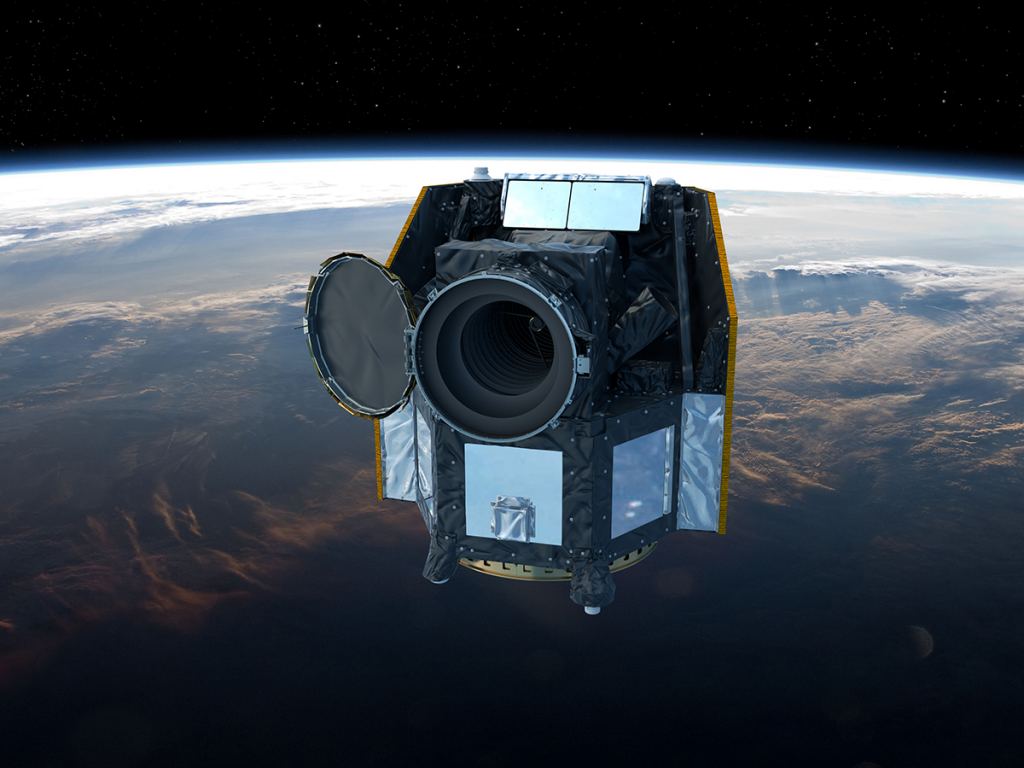
“The good news is that the actual blurred images received are smoother and more symmetrical than what we expected from measurements performed in the laboratory,” says Benz. The blurred testing is designed to spread incoming light over as many pixels as possible. The results will tell the CHEOPS team if the telescope is smoothing out its jitters and its “pixel-to-pixel variations.” That smoothing is what will give CHEOPS its exceptional precision.


Artist’s impression of CHEOPS © ESA / ATG medialab
Even though it’s blurry, it’s the first image. And that makes it a milestone for the ESA and the CHEOPS team.
“This is a defining moment for the mission,” said Nicola Rando, ESA project manager for Cheops, in a press release.
“To the engineers and scientists across Europe who have worked and continue to work on Cheops, this image represents the culmination of many years of dedication and effort – designing, planning, coordinating and building this new and unique satellite,” said Rando.


“These initial promising analyses are a great relief and also a boost for the team.”
WILLY BENZ, PRINCIPAL INVESTIGATOR, CHEOPS MISSION.
These tests are all about the precision that CHEOPS needs to fulfill its mission. CHEOPS isn’t a planet-finding mission. It’s going to examine already-known exoplanets with extreme precision. It needs to sense extremely small dips in brightness as an exoplanet transits in front of its star. Since it’s the size of the planet that determines that dip, the more precisely CHEOPS can measure the dip, the more precisely it can determine the size of the planet.
“These initial promising analyses are a great relief and also a boost for the team,” said Benz.

This is just the beginning of CHEOPS’ testing phase. Over the course of about two months, the satellite will take more images. The overall goal of all these tests is to determine how accurate the spacecraft can be during different parts of its mission. “We will analyze many more images in detail to determine the exact level of accuracy that can be achieved by CHEOPS in the different aspects of the science program,” said David Ehrenreich, CHEOPS project scientist at the University of Geneva. “The results so far bode well.”


The CHEOPS mission, like all space missions, has been years in development. Milestones like these are important, and are gratifying to the people who work on the mission.
“Now that Cheops has observed its first target, we are one step closer to the start of the mission science,” said Kate Isaak, ESA Cheops project scientist. “This beautifully blurred image carries the promise of a new, deeper understanding of worlds beyond our Solar System.”
The Kepler mission revolutionized our understanding of exoplanets. Its results confirmed what many had guessed: most stars host planets, just like our Solar System does. Now, thanks largely to Kepler, we know of over 4000 confirmed exoplanets. CHEOPS represents the next step in characterizing and understanding exoplanets.


Preliminary looks at exoplanets were nowhere near as precise as what CHEOPS will provide. Ground-based measurements can give us a pretty good idea of an exoplanet’s mass. As a planet orbits its star, it gives the star a little tug. From that tug, astronomers can calculate the planet’s mass. But the planet’s density, and it’s composition, are not revealed.
But the precise size measurements from CHEOPS, when combined with a planet’s mass measurement, give us a much more accurate density, and hence, composition. That’s how CHEOPS will advance exoplanet science.
“CHEOPS will take exoplanet science to a whole new level,” says Günther Hasinger, ESA Director of Science.
“After the discovery of thousands of planets, the quest can now turn to characterization, investigating the physical and chemical properties of many exoplanets and really getting to know what they are made of and how they formed. CHEOPS will also pave the way for our future exoplanet missions, from the international James Webb Telescope to ESA’s very own PLATO and ARIEL satellites, keeping European science at the forefront of exoplanet research.”


Artist's concept of Jupiter-sized exoplanet that orbits relatively close to its star (aka. a "hot Jupiter"). Credit: NASA/JPL-Caltech)
Artist’s concept of Jupiter-sized exoplanet that orbits relatively close to its star (aka. a “hot Jupiter”). Credit: NASA/JPL-Caltech)
The CHEOPS mission will last about 3.5 years. 80% of that time will be taken up by the CHEOPS Guaranteed Time Observing (GTO) program. Most of the GTO program time will be used mostly to observe known exoplanets, and to characterize them in more detail.
As Kepler showed, exoplanets come in a wide variety of types, many of which are very different from what we see in our Solar System. They include Hot Jupiters, which are massive gas giants that orbit super close to their star. There are tidally-locked planets with molten surfaces. There may be ocean planets with no land area. And there are planets so close to their star that the gravity warps them into an egg-like shape. CHEOPS will grow our understanding of all of these types of planets we’re finding. The planets it characterizes will likely be targets for further study with even more powerful telescopes like the James Webb Space Telescope.
The CHEOPS GTO will also look at exoplanets found with the radial velocity method, and will observe their transits to find their sizes. It will also look at other solar systems with multiple exoplanets, and try to find any others that were missed.


Some stars are known to host multiple exoplanets. Part of the CHEOPS mission is to look at some of those solar systems and try to find other planets that were missed. The three planets discovered in the L98-59 system by NASA’s Transiting Exoplanet Survey Satellite (TESS) are compared to Mars and Earth in order of increasing size in this illustration. Credit: NASA’s Goddard Space Flight Center
The other 20% of CHEOPS’ time will be available to the astronomy community under the Guest Observers (GO) program. Some of that time has already been allotted to study some the Hot Jupiter HD 17156 b, the exoplanet DS Tuc Ab which TESS found, and the multi-planet system GJ 9827. One of the planets orbiting GJ 9827 is the densest ever found, and may be 50% iron, making it a very intriguing candidate for follow-up observations.
CHEOPS’ science program should begin in April 2020, and will end around October 2023.

More:

 Fuente: https://www.universetoday.com/144967/here-are-the-first-pictures-from-cheops/


domingo, 5 de enero de 2020

La física matemática que probó que el futuro del universo está bien definido

Yvonne Choquet-Bruhat, que acaba de cumplir 96 años, encontró solución al llamado problema de Cauchy para las ecuaciones de Einstein de vacío


teorema de cauchy
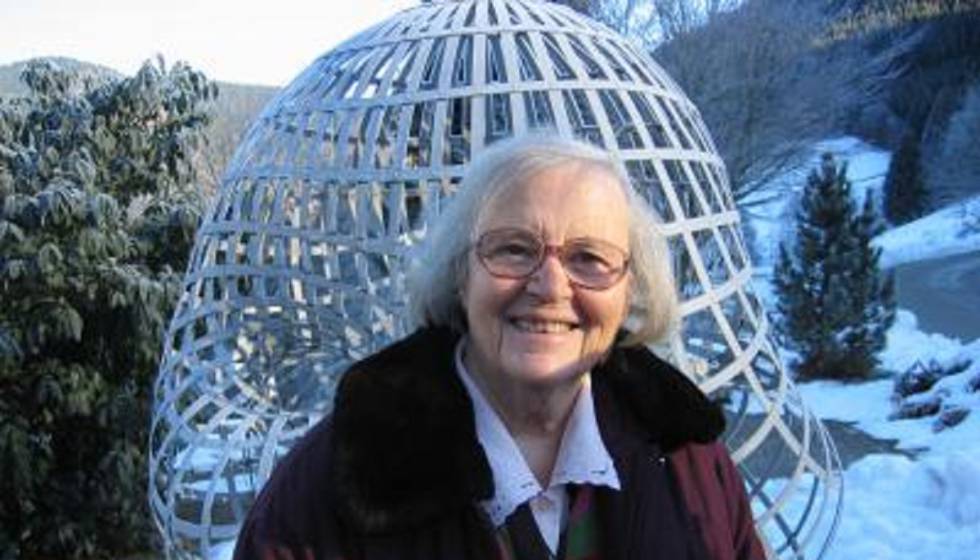
La matemática francesa Yvonne Choquet-Bruhat, en una imagen tomada en 2006. RENATE SCHMID
El filósofo español José Ortega y Gasset afirmaba: “Sorprenderse, extrañarse… es comenzar a entender”. La misma idea empujó desde niña a Yvonne Choquet-Bruhat a querer “desentrañar alguno de los secretos del extraño universo en que vivimos, y del papel que los seres humanos jugamos en él”, como expresa en su autobiografía. La científica francesa, que el pasado 29 de diciembre cumplió 96 años, siempre ha confiado en que la física y las matemáticas nos podrían ayudar a llevar a cabo tal empeño. Sus contribuciones, enmarcadas fundamentalmente en el campo de la relatividad general, la han convertido en una destacada figura en el área de la física matemática del siglo XX.
Yvonne Choquet-Bruhat –el apellido “Choquet” lo adquirió en su segundo matrimonio con Gustave Choquet– nació en Lille (Francia) en el seno de una familia culta. Su padre, Georges Bruhat (1887-1945), fue profesor de física en la Universidad de Lillle, y su madre, Berthe Hubert (1892-1972), profesora de arte, literatura y filosofía en varios liceos franceses. Desde una temprana edad, Choquet-Bruhat mostró un gran talento para la física y las matemáticas. A los dieciocho años ganó una medalla de plata del “Concours General”, una competición a nivel nacional en la que se premiaba a los mejores estudiantes del país. En 1943 comenzó sus estudios de Matemáticas en la Escuela Normal Superior de Sévres, en las afueras de París, donde se graduó tres años más tarde.

Fue entonces cuando empezó su actividad investigadora en el prestigioso Centro Nacional de Investigación Científica francés (CNRS por sus siglas en francés), bajo el asesoramiento del reconocido físico matemático André Lichnerowicz. Realizó su tesis sobre el llamado problema de valor inicial (o problema de Cauchy) en el contexto de la relatividad general, en el que se estudia la existencia de soluciones para las ecuaciones planteadas por Albert Einstein, cuando éstas cumplen determinadas condiciones de partida. En el marco cosmológico, la cuestión determinaría si el futuro del universo está bien definido cuando sólo contamos con la información del mismo en un “tiempo concreto”, lo que se conoce como dato inicial del problema.
Choquet-Bruhat logró probar, mediante el estudio de complejas ecuaciones diferenciales y técnicas geométricas, que si se parte de un dato inicial que cumple ciertas restricciones físicas plausibles, hay únicamente un futuro posible para el universo
Choquet-Bruhat logró probar, mediante el estudio de complejas ecuaciones diferenciales y técnicas geométricas, que si se parte de un dato inicial que cumple ciertas restricciones físicas plausibles, hay únicamente un futuro posible para el universo. Su trabajo doctoral, que tiene por título “Théorème d’existence pour certains systèmes d’equations aux dérivées partielles non linéaires”, pone de manifiesto la naturaleza determinista de la teoría de Einstein, pues el futuro del universo queda fijado por la información que lo describe en un instante de tiempo.
En 1949 Choquet-Bruhat fue nombrada investigadora asistente del CNRS, y más tarde asociada. En 1951 aceptó un contrato postdoctoral en el Instituto de Estudios Avanzados de Princeton en EE UU Allí tuvo la oportunidad de conocer a Einstein, a quien pudo explicar en su despacho, con una combinación de francés e inglés, los principales logros de su tesis. El genio alemán la felicitó por el trabajo realizado y la invitó a visitarle a su despacho siempre que quisiera.
La solución al problema de Cauchy ha fundamentado, entre otros campos de investigación, el estudio de la estabilidad de las soluciones de las ecuaciones de Einstein, que analiza cuánto varían los universos que surgen de ligeras perturbaciones del dato inicial. ¿Se obtiene un universo ligeramente diferente al previsto, o por el contrario no tendría casi nada que ver con él? Por otra parte, este trabajo facilitó el uso técnicas numéricas y analíticas para aproximar las soluciones de las ecuaciones de Einstein, ya que habitualmente son muy difíciles de calcular de forma explícita. Aparte, más allá de su importancia dentro la teoría de la relatividad general, el trabajo de Choquet Bruhat ha establecido las bases para el estudio de otras teorías físicas como la hidrodinámica relativista, la teoría Gauge no abeliana o la supergravedad.
Entre otros méritos, destaca el haber sido la primera mujer elegida para formar parte de la Academia de las Ciencias Francesa
La fecunda trayectoria científica de la física matemática ha dado como fruto un total de siete libros y trescientos artículos, que la han hecho merecedora de importantes premios y galardones nacionales e internacionales. Entre otros méritos, destaca el haber sido la primera mujer elegida para formar parte de la Academia de las Ciencias Francesa, el 14 de mayo de 1979.
En las últimas líneas de su autobiografía, la científica francesa rememora una reflexión del filósofo Blaise Pascal, en la que éste admite tener “una tremenda ignorancia de todo”. A pesar de que Choquet-Bruhat reconozca la ingente cantidad de preguntas que quedan por responder, sus contribuciones han significado un avance científico considerable.
Después de una vida dedicada a la investigación, Yvonne Choquet-Bruhat ha podido ver cumplido el sueño de su infancia: aportar luz sobre algunos de los misterios del universo en que nos toca vivir.

lunes, 30 de diciembre de 2019

Waiting for Betelgeuse: What’s Up with the Tempestuous Star?


Betelgeuse

Have you noticed that Orion the Hunter—one of the most iconic and familiar of the wintertime constellations—is looking a little… different as of late? The culprit is its upper shoulder star Alpha Orionis, aka Betelgeuse, which is looking markedly faint, the faintest it has been for the 21st century.

When will this nearby supernova candidate pop, and what would look like if it did?
The story starts, as all good astronomy and space stories seem to, on Friday night going into a holiday weekend. We started seeing discussion on Betelgeuse trending on social media on the evening of Friday, December 20th, and dug down to the source of the excitement: a December 8th paper on ‘The Fainting of the Nearby Red Supergiant Betelgeuse’ by researchers at Villanova University. Light curve estimates courtesy of the American Association of Variable Star Observers (AAVSO) verified the assertion that the star had indeed faded about one magnitude, or a little over one half from its usual magnitude +0.5 to +1.5. Noticing the sky was clear, we headed up to our parking garage rooftop observing site in downtown Norfolk, Virginia to take a look. Betelgeuse was indeed noticeably fainter, about a shade dimmer than nearby +1st magnitude Aldebaran.


Magnitude estimates of Betelgeuse, going back to 1970. Credit: The AAVSO.

Now, a change in one magnitude isn’t unusual for a variable star such as Betelgeuse… but such a large dip always gives the astronomical community pause. A red giant star 12 times as massive as our Sun and about 700 light years distant, the variability of red-orange Betelgeuse was first noted by astronomer Sir John Herschel in 1836. Physically, the star is currently bloated out to a radius of perhaps eight Astronomical Units (AU). If you plopped it down in the center of our solar system, Betelgeuse might extend all the way out to past the orbit of Jupiter.


Our (puny) host star, versus the neighbors, including Betelgeuse. Credit: Dave Dickinson

This fact also allowed astronomers to use the first crude optical interferometric measurements from the 2.5 meter telescope at Mount Wilson Observatory to measure Betelgeuse’s physical diameter of 50 milliarcseconds. In the late 1980s, astronomers used in emerging technique of aperture masking interferometry to obtain the first direct ‘image’ of Betelgeuse.


A pulsating Betelgeuse in the ultraviolet. Credit: NASA/HST

Betelgeuse is always worth keeping an eye on, as it’s one of the closest candidates in our galaxy for a nearby supernova. We see supernovae frequently in distant galaxies, but such an event has not been witnessed in our galaxy in the telescopic era: Kepler’s Star in 1604 in the constellation Ophiuchus was the last supernova observed in the Milky Way, though a supernova in the nearby Large Magellanic Cloud put on a good show in 1987. A red giant like Betelgeuse lives fast and dies young, exhausting its supply of hydrogen fuel in just under 10 million years. The star is destined to undergo a core implosion and massive collapse and rebound as a Type II supernova. Such an explosion could occur 100,000 years from now… or tonight.


Still fading… our brief smartphone capture of Betelgeuse and Orion from Virginia Beach on Christmas Day 2019. Credit Dave Dickinson

Is the fading act a prelude to a truly spectacular show, or a false alarm? Astronomers are unsure, but a supernova event just 700-odd light-years away would be an unrepresented opportunity to study one up close. Not only would every optical telescope get trained on the exploding star, but assets such as the Laser Interferometry Gravitational Wave Observatory (LIGO) could detect gravitational waves from a nearby supernova, and neutrino observatories such as Ice Cube buried in the Antarctic ice could detect the event as well.
…and fortunately for us, we’re safely out of the 50 light-year ‘kill zone’ for receiving any inbound lethal radiation from Betelgeuse: a supernova would simply be a scientifically interesting event, and put on a good show. Ancient supernovae may have had a hand in the evolution of life on Earth, and a recent study suggests that one might even have forced early humans to walk upright. Here’s the rogues gallery list of stars that are current nearby supernovae candidates:


Nearby supernova candidates out to 1,000 light-years. Credit: Dave Dickinson

What would a supernova in Orion look like? Well, using the last supernova in the Large Magellanic Cloud (also a Type IIb event) as a guide, we calculate that when it does blow, Betelgeuse would shine at magnitude -10. That’s 16 times fainter than a Full Moon, but 100 times brighter than Venus, making it easily visible in the daytime sky. A Betelgeuse-gone-supernova would also easily cast noticeable nighttime shadows.
But see the ongoing fading event for yourself. Betelgeuse is easy to find in December, rising to the east at dusk. In fact, northern hemisphere winter is the very best time for the star to blow, as it’s roughly opposite to the Sun, and would dominate the night sky. Summer would be the worst time, as it would tease us from beyond the far side with the Sun in the daytime sky.
You can even guesstimate Betelgeuse’s brightness yourself, using the nearby stars of the Winter Hexagon asterism as a guide:


Betelgeuse, versus the stars of the Winter Hexagon with annotated magnitudes (note: this was taken prior to the current dimming event). Image credit and copyright: Steve Brown.

What’s next? Well, expect Betelgeuse to brighten again in early 2020… though if it rebounds into negative magnitude territory past Rigel and Sirius, well, then things could get really exciting.
For now though, we’re in a wait-and-see-mode for any New Year’s Eve fireworks from Betelgeuse. Such an occurrence would be bittersweet: we would be extraordinarily lucky to see Betelgeuse go supernova in our lifetime… but familiar Orion the Hunter would never look the same again.
Lead image: Orion with a fading Betelgeuse from December 21st, 2019 courtesy of Alan Dyer.

viernes, 13 de diciembre de 2019

Detectada la luz más potente del universo

Dos telescopios de Canarias aclaran cómo suceden las mayores explosiones del cosmos

el universo
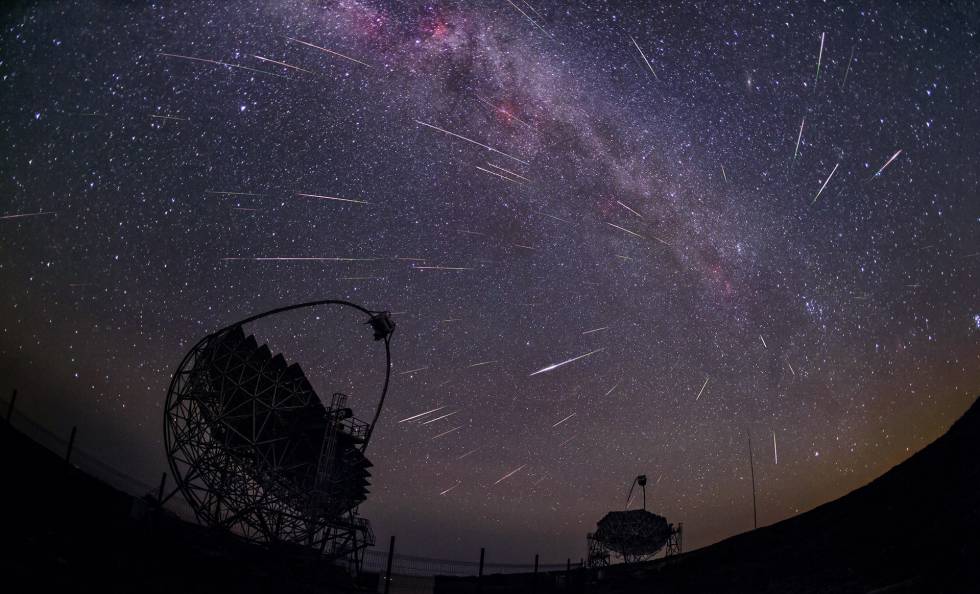
Las dos antenas de MAGIC, durante la lluvia de Perseidas en 2016. DANIEL LÓPEZ
El 14 de enero la astrofísica Elena Moretti recibió una llamada que no olvidará fácilmente. “¿Esta señal que estamos viendo es un simulacro?”, dijeron al otro lado del teléfono. Era de noche cerrada en el Observatorio del Roque de los Muchachos, una cima de origen volcánico en la isla de La Palma ideal para la observación astronómica. La científica saltó de la cama y en dos minutos estaba frente a las pantallas del centro de control. No era un simulacro: los dos telescopios MAGIC habían captado claramente un grupo de fotones —partículas de luz— que era unas 100 veces más potentes que cualquier otro detectado antes.
“Aunque lo veía delante de mis ojos no podía creerlo”, explica Moretti. Todo había comenzado tres minutos antes de las nueve de la noche, cuando dos telescopios espaciales, Swift y Fermi, detectaron un potente estallido de rayos gamma. En unos 20 segundos enviaron una alerta a la Tierra. De forma totalmente automática, las dos imponentes antenas de 64 toneladas de los telescopios MAGIC giraron sobre sí mismas 35 segundos después para apuntar justo al punto del cielo desde el que llegaba la señal, que duró unos 30 minutos.
“Esa noche nos quedamos trabajando unas cuatro horas más. La señal fue debilitándose y después desapareció detrás del horizonte. Enviamos una nota de alerta al resto de la comunidad astrofísica internacional para que intentaran seguir observándola”, recuerda la astrofísica, que trabaja en el Instituto de Física de Altas Energías, en Barcelona.
Los resultados de las observaciones de los MAGIC y de muchos otros observatorios espaciales y terrestres se publican este miércoles en la prestigiosa revista científica Nature. Dos estudios confirman que los MAGIC han sido los primeros en captar el grupo de fotones con más energía que se han observado después de un estallido de rayos gamma. Estas son las mayores explosiones del universo actual, capaces de liberar en apenas 100 segundos la misma energía que emitirá el Sol en lo que le queda de vida (unos 10.000 millones de años).
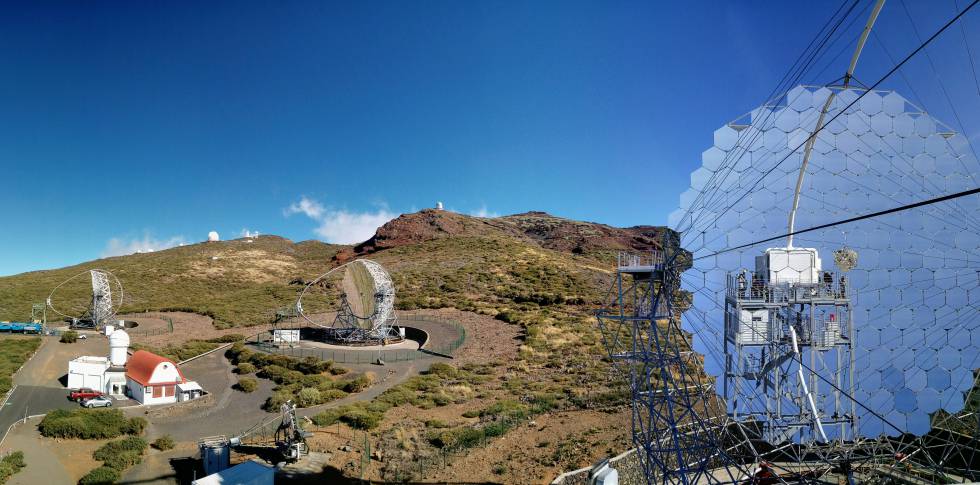
Los telescopios MAGIC, en el Observatorio del Roque de los Muchachos de la isla de La Palma.
Los telescopios MAGIC, en el Observatorio del Roque de los Muchachos de la isla de La Palma. ALICIA LÓPEZ-ORAMAS
Los fotones registrados tienen una energía media de un teraelectronvoltio, un billón de veces más que los fotones convencionales que podemos ver los humanos. “Esta es la luz más potente que se ha captado teniendo en cuenta la cantidad de energía liberada y el tiempo que duró el estallido”, explica Moretti. “En el universo conocemos otras fuentes capaces de emitir luz así de potente, como los núcleos de galaxias activos [agujeros negros], pero tardan miles de millones de años en hacerlo”, destaca.
Esta detección aclara la física de las emisiones de rayos gamma y demuestra por primera vez que pueden alcanzar mucha más energía de lo que se pensaba. “Durante 20 años hemos estado recibiendo señales de fuentes de rayos gamma, unas 110 en total, pero nunca habíamos visto algo tan escandaloso, tan impresionante”, resalta María Victoria Fonseca, astrofísica de la Universidad Complutense de Madrid que trabaja en MAGIC —siglas inglesas de Telescopio de Rayos Gamma por Emisión de Radiación Cherenkov en la Atmósfera— desde que sus telescopios comenzaron a funcionar en 2004.
Los investigadores creen que el brote de rayos gamma proviene de una estrella con 10 veces más masa que el Sol que estalló tras consumir todo su combustible de hidrógeno. También han podido calcular la distancia que han viajado los fotones hasta llegar a la Tierra: 4.500 millones de años luz. Esto significa que la estrella explotó cuando se estaba formando nuestro planeta, cientos de millones de años antes de que apareciesen las primeras formas de vida.
Tras la explosión estelar se generaron dos potentes haces de rayos gamma y rayos x que salieron disparados en direcciones opuestas. Después de esta fase de emisión rápida, la metralla escupida por el astro generó una onda de choque que comprimió el medio interestelar formando plasma y un intenso campo magnético en el que los electrones quedaron atrapados en una trayectoria circular hasta alcanzar altas energías y velocidades cercanas a la de la luz. Es el fenómeno conocido como sincrotrón en el que se basan los aceleradores de partículas que, en la Tierra, permiten hacer imagen médica por rayos x o penetrar en la materia sin dañarla para descubrir pinturas ocultas en lienzos de Picasso, Van Gogh o Degas.
En 1923, el físico estadounidense Arthur Compton descubrió que un fotón podía chocar con un electrón y pasarle parte de su energía, el efecto Compton que le valió el Nobel de física en 1927. Los investigadores de MAGIC creen que lo que han observado es el efecto inverso de Compton en el que son los electrones acelerados los que ceden parte de su energía a los fotones hasta que estos rompen la barrera de los teraelectronvoltios. Es una posibilidad predicha por la teoría pero nunca confirmada hasta ahora.
"¿Por qué hemos tardado tantos años en detectar este fenómeno?”, se pregunta Bing Zhang, físico de la Universidad de Nevada (EE UU), en una opinión publicada junto a los artículos. Aunque se piensa que hay un estallido de rayos gamma al día, solo son detectables a estas energías los que son muy potentes y suceden relativamente cerca de la Tierra. Además, tiene que ser de noche y es necesario que haga buen tiempo y que la luz llegue a una zona donde haya telescopios. El físico explica que la detección de este tipo de luz se hará “rutinaria” en poco tiempo gracias al trabajo de detectores como el HAWC, en la ladera del volcán Sierra Negra (México), o la red de Telescopios Cherenkov, en La Palma y en Chile, y el observatorio de Daocheng, en China.


viernes, 25 de octubre de 2019

Astronomers See Strontium in the Kilonova Wreckage, Proof that Neutron Star Collisions Manufacture Heavy Elements in the Universe


Astronomers have spotted Strontium in the aftermath of a collision between two neutron stars. This is the first time a heavy element has ever been identified in a kilonova, the explosive aftermath of these types of collisions. The discovery plugs a hole in our understanding of how heavy elements form.
In 2017, the Laser Interferometer Gravitational-Wave Observatory (LIGO) and the European VIRGO observatory detected gravitational waves coming from the merger of two neutron stars. The merger event was named GW170817, and it was about 130 million light years away in the galaxy NGC 4993.

The resulting kilonova is called AT2017gfo, and the European Southern Observatory (ESO) pointed several of their telescopes at it to observe it in different wavelengths. In particular, they pointed the Very Large Telescope (VLT) and its X-shooter instrument at the kilonova.

This chart shows the sprawling constellation of Hydra (The Female Sea Serpent), the largest and longest constellation in the sky. Most stars visible to the naked eye on a clear dark night are shown. The red circle marks the position of the galaxy NGC 4993, which became famous in August 2017 as the site of the first gravitational wave source that was also identified in light visible light as the kilonova GW170817. NGC 4993 can be seen as a very faint patch with a larger amateur telescope. Image Credit:  ESO, IAU and Sky & Telescope
This chart shows the sprawling constellation of Hydra (The Female Sea Serpent), the largest and longest constellation in the sky. Most stars visible to the naked eye on a clear dark night are shown. The red circle marks the position of the galaxy NGC 4993, which became famous in August 2017 as the site of the first gravitational wave source that was also identified in light visible light as the kilonova GW170817. NGC 4993 can be seen as a very faint patch with a larger amateur telescope. Image Credit: ESO, IAU and Sky & Telescope
The X-shooter is a multi-wavelength spectrograph that observes in Ultraviolet B (UVB,) visible light, and Near Infrared (NIR.) Initially, X-shooter data suggested that there were heavier elements present in the kilonova. But until now, they couldn’t identify individual elements.
“This is the final stage of a decades-long chase to pin down the origin of the elements.”
Darach Watson, Lead Author, University of Copenhagen.
These new results are presented in a new study titled “Identification of strontium in the merger of two neutron stars.” The lead author is Darach Watson from the University of Copenhagen in Denmark. The paper was published in the journal Nature on 24 October 2019.
“By reanalysing the 2017 data from the merger, we have now identified the signature of one heavy element in this fireball, strontium, proving that the collision of neutron stars creates this element in the Universe,” said Watson in a press release.

This artist’s impression shows two tiny but very dense neutron stars merging and exploding as a kilonova. Such objects are the main source of very heavy chemical elements, such as gold and platinum, in the Universe. The detection of one element, strontium (Sr), has now been confirmed using data from the X-shooter instrument on ESO’s Very Large Telescope.
The forging of the chemical elements is called nucleosynthesis. Scientists have known about it for decades. We know that elements form in supernovae, in the outer layers of aging stars, and in regular stars. But there’s been a gap in our understanding when it comes to neutron capture, and how heavier elements are formed. According to Watson, this discovery fills that gap.
“This is the final stage of a decades-long chase to pin down the origin of the elements,” says Watson. “We know now that the processes that created the elements happened mostly in ordinary stars, in supernova explosions, or in the outer layers of old stars. But, until now, we did not know the location of the final, undiscovered process, known as rapid neutron capture, that created the heavier elements in the periodic table.”
There are two types of neutron capture: rapid and slow. Each type of neutron capture is responsible for the creation of about half of the elements heavier than iron. Rapid neutron capture allows an atomic nucleus to capture neutrons quicker than it can decay, creating heavy elements. The process was worked out decades ago, and circumstantial evidence pointed to kilonovae as the likely place for the rapid neutron capture process to take place. But it was never observed at an astrophysical site, until now.

This animation is based on a series of spectra of the kilonova in NGC 4993 observed by the X-shooter instrument on ESO’s Very Large Telescope in Chile. They cover a period of 12 days after the initial explosion on 17 August 2017. The kilonova is very blue initially but then brightens in the red and fades.
Credit:ESO/E. Pian et al./S. Smartt & ePESSTO/L. Calçada
Stars are hot enough to produce many of the elements. But only the most extreme hot environments can create heavier elements like Strontium. Only those environments, like this kilonova, have enough free neutrons around. In a kilonova, atoms are constantly bombarded by massive numbers of neutrons, allowing the rapid neutron capture process to create the heavier elements.
“This is the first time that we can directly associate newly created material formed via neutron capture with a neutron star merger, confirming that neutron stars are made of neutrons and tying the long-debated rapid neutron capture process to such mergers,” says Camilla Juul Hansen from the Max Planck Institute for Astronomy in Heidelberg, who played a major role in the study.
Even though the X-shooter data has been around for a couple years, astronomers weren’t certain that they were seeing strontium in the kilonova. They thought they were seeing it, but couldn’t be sure right away. Our understanding of kilonovae and neutron star mergers is far from complete. There are complexities in the X-shooter spectra of the kilonova that had to be worked through, specifically when it comes to identifying the spectra of heavier elements.

On 17 August 2017, the Laser Interferometer Gravitational-Wave Observatory (LIGO) and the Virgo Interferometer both detected gravitational waves from the collision between two neutron stars. Within 12 hours observatories had identified the source of the event within the lenticular galaxy NGC 4993, shown in this image gathered with the NASA/ESA Hubble Space Telescope. The associated stellar flare, a kilonova, is clearly visible in the Hubble observations. This is the first time the optical counterpart of a gravitational wave event was observed. Hubble observed the kilonova gradually fading over the course of six days, as shown in these observations taken in between 22 and 28 August (insets). By ESA/Hubble, CC BY 4.0, https://commons.wikimedia.org/w/index.php?curid=63442000
“We actually came up with the idea that we might be seeing strontium quite quickly after the event. However, showing that this was demonstrably the case turned out to be very difficult. This difficulty was due to our highly incomplete knowledge of the spectral appearance of the heavier elements in the periodic table,” says University of Copenhagen researcher Jonatan Selsing, who was a key author on the paper. 
Up until now, rapid neutron capture was much debated, but never observed. This work fills in one of the holes in our understanding of nucleosynthesis. But it goes further than that. It confirms the nature of neutron stars.
After the neutron was discovered by James Chadwick in 1932, scientists proposed the existence of the neutron star. In a 1934 paper, astronomers Fritz Zwicky and Walter Baade advanced the view that “a super-nova represents the transition of an ordinary star into a neutron star, consisting mainly of neutrons. Such a star may possess a very small radius and an extremely high density.”
Three decades later, neutron stars were linked and identified with pulsars. But there was no way to prove that neutron stars were made of neutrons, because astronomers couldn’t obtain spectroscopic confirmation.
But this discovery, by identifying strontium, which could only have been synthesized under extreme neutron flux, proves that neutron stars are indeed made of neutrons. As the authors say in their paper, “The identification here of an element that could only have been synthesized so quickly under an extreme neutron flux, provides the first direct spectroscopic evidence that neutron stars comprise neutron-rich matter.”
This is important work. The discovery has plugged two holes in our understanding of the origin of elements. It confirms observationally what scientists knew theoretically. And that’s always good.

domingo, 13 de octubre de 2019

Un nuevo asteroide podría impactar contra la Tierra

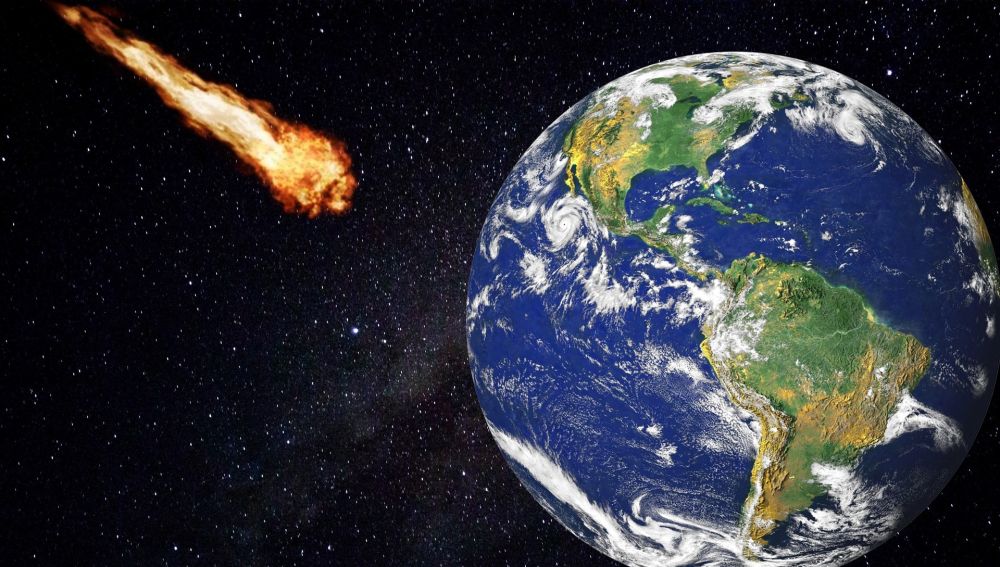
Asteroide que se dirige a impactar contra la Tierra


La Agencia Espacial Europea (ESA) ha incorporado un asteroide recién descubierto a su lista de objetos con riesgo de impacto sobre la Tierra y lo ha clasificado como el cuarto más peligroso.

 EN RESUMEN
  • El meteorito mide 14 metros de diámetro
  • La ESA lo ha calificado como el cuarto más peligroso de su lista
  • El impacto tendría lugar el 16 de septiembre del año 2084
Desde hace años, la Agencia Espacial Europea (ESA) elabora una 'Lista de objetos con riesgo de impacto en la Tierra'. Tras los últimos descubrimientos, han incorporado un nuevo asteroide.
El meteorito fue descubierto el pasado 23 de septiembre y tiene unos 14 metros de diámetro. Los investigadores lo han clasificado como el cuarto más peligroso de la lista. Además de la 'Lista de riesgos', el SU3 2019, como ha sido identificado, también se encuentra en la 'Lista de Prioridades de la agencia', lo que significa que la ESA vigila de cerca su trayectoria.
Según los investigadores, las posibilidades del asteroide de golpear la Tierra son una entre 147 y, en el caso de que suceda, tendría lugar dentro de 65 años.
Se espera que el asteroide se vaya acercando desde una distancia de solo 0,00079 unidades astronómicas, aproximadamente a 118.000 kilómetros de distancia. Esta distancia es muy pequeña, por lo que un ligero empujón podría enviarlo a la tierra. De hacerlo, el potencial impacto tendría lugar el 16 de septiembre del año 2084.
Según la ESA, se trata de un asteroide Apollo con una órbita muy amplia alrededor de la Tierra y el Sol que, ocasionalmente, se cruza con la de la Tierra. Cuando el meteorito completa su órbita, a veces pasa cerca de otros planetas como Venus, Mercurio y Marte. La atracción de gravedad de cualquiera de estos planetas podría alterar fácilmente la trayectoria del asteroide.
El asteroide no es lo suficientemente grande como para causar un impacto importante en caso chocar contra la Tierra, ya que tiene un diámetro de 14 metros. Lo más probable es que estalle en la atmósfera.

Captada una señal de ondas gravitacionales nunca vista

  Los detectores LIGO y Virgo captan dos choques de agujeros negros contra estrellas de neutrones, los astros más densos del universo. Dos d...